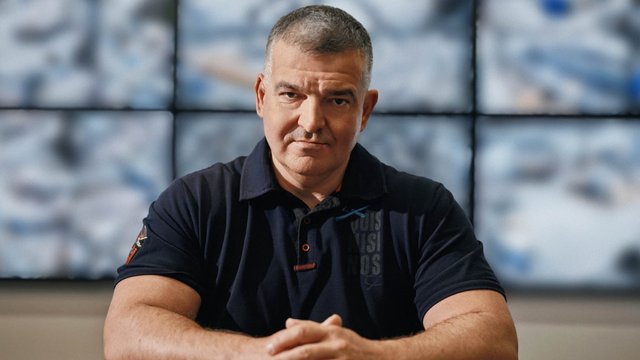
Ukraine's anti-ballistic missile system, working under the codename "Freya," could be ready by the end of this year if partner countries facilitate its development. However, Ukraine will produce its own ballistic weapons much sooner, and by this fall at the latest, it will be capable of striking Russian territory, says Denys Shtilerman, chief designer and co-owner of the defense company Fire Point.
"I expect that this summer, or at the latest in early fall, we'll begin test flights to Moscow. And since we never wait for approval and codification, but build production lines immediately, we never make one, two, or three copies of anything there—we immediately produce ten test copies. We'll make 10-20 missiles there and start producing them. Then, once we've been codified, once they buy us, dozens will be produced there," Shtilerman said in an interview with journalist Olesia Batsman, posted on YouTube.
He explained that the ballistic missile's engine "hasn't been tested yet." "We'll test the engine this month, and I expect to begin test flights soon. As soon as the test flight shows everything is working properly, the next test flights should begin there, in Moscow," the chief designer said.
Regarding the development of our own anti-ballistic air defense system, he noted that "we are eagerly awaiting permission from European authorities for large German companies, as well as from other countries, to provide us with their equipment, as we don't have the time to produce either the seeker head or high-quality radars." "We hope to receive the first device next week or even this week, with which we will begin integration—that is, seekers, multiple radars, and a command and control center," said the Fire Point co-owner.
When asked whether this system would be similar to the American Paatriot air defense system, he replied that "Europe will have its own anti-ballistic shield system, built on an open architecture, and most importantly, it will not have a call switch, meaning no one can remotely turn it off. Any buyer, any country that buys it, that deploys it for its own defense, will be confident that neither the manufacturer nor the selling country will ever be able to turn off this system." "This is very important. We are selling not only security, but also the independence of our security," Shtilerman emphasized.
According to him, the developers aim to reduce the cost of one interception to less than $1 million, while one interception by the Patriot system currently costs about $6 million. The system itself will cost about $150,000 and will contain four missiles.
"We called it 'Freya,' until officials accepted the name, but we still call it 'Freya.' In official discourse, it's called the 'European Anti-Ballistic Shield,'" the company's chief designer said.
Shtilerman emphasized that its readiness timeline depends heavily on "whether our European partners can keep up a fast pace." "I want the Europeans to start moving quickly. They've started rethinking things, and they're starting to move. If everything moves quickly, we'll be able to conduct the first intercepts this year," he said.
However, according to the co-owner of Fire Point, "if this all happens like it did in Europe, where it takes 8-9 months to obtain permission, then, unfortunately, nothing will happen." "Because Ukraine doesn't have sufficient or operational homing heads, nor do we yet know how to produce radars. Now our state-owned enterprise, which once produced them, is starting to make something, but it's not yet the radars needed to intercept ballistic missiles," Shtilerman emphasized.
When asked about targets in Russia that Ukrainian ballistic missiles could strike, he replied that "the military is handling that." "But I think we're facing winter, and we have two options for surviving it. The first option is to learn to effectively intercept their ballistic missiles and also obtain Patriot missiles from our partners, which will cover Kyiv. The second option—the more realistic one—is to strike some key, significant targets in Moscow and exchange the fact that you don't strike our civilian infrastructure for us not to strike yours, and let's fight peacefully using conventional methods," the Fire Point co-owner believes.
He also emphasized that Russia "has really started to lose" and therefore isn't above targeted terror against the civilian population. Furthermore, the chief designer noted that "any ceasefire with Russia, any treaties with Russia, are worthless."
He also expressed his belief that Ukraine could easily develop its own nuclear weapons, but is not doing so because it adheres to its international commitments, accepted in exchange for security guarantees from partners who "don't fulfill theirs, but we are fulfilling ours for now." When asked whether Ukraine could again become a nuclear power and under what conditions, he replied: "Of course, it's a very simple process, and everything is clear." "It's a matter of political decision, and that's all. And we must give credit to our leadership for fulfilling its obligations regarding Ukraine's nuclear status," Shtilerman concluded.