

Ministry of Economy plans to withdraw non-inherent functions from State Water Resources Agency in 2026 – minister
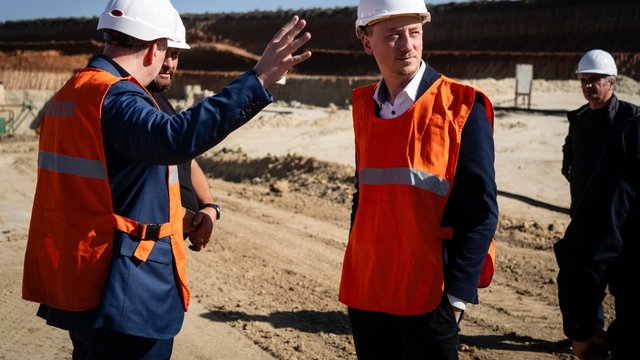
The Ministry of Economy, Environment and Agriculture sets a goal for 2026 to withdraw non-inherent functions from the State Water Resources Agency: maintenance of outdated and worn-out infrastructure, management of assets that are not used or create environmental and financial risks, Minister of Economy, Environment and Agriculture Oleksiy Sobolev said.
"Instead, the agency should focus on its core role – strategic management of water resources based on a basin approach, using data, forecasting, and long-term scenarios," he said in an interview with Interfax-Ukraine.
According to him, the transfer of the State Water Resources Agency to the Ministry of Economy allows for the removal of unnecessary interagency barriers and speeds up decision-making, especially where water policy directly intersects with the economy, agriculture, and reconstruction.
"In this model, water is seen as a strategic resource for development, security, and sustainable recovery, rather than solely as an environmental issue. This aligns with the European logic of integrated water resources management based on the basin principle," Sobolev emphasized.
He noted that the current model of water management contains an inherent conflict of interest, as the agency, which by its nature should safeguard the rational use and conservation of water resources, remains effectively involved in the operational activities of water management organizations.
"Following this logic, the more water is supplied, the higher the revenues to special accounts, which undermines the motivation for water conservation, efficiency improvements, and environmental responsibility. Such a system contradicts both environmental goals and the principles of sustainable management," the minister explained.
The Minister of Economy emphasized that under the new model, the state is shifting from incentivizing water consumption volumes to achieving clear water-ecological objectives, including ensuring good ecological and chemical status of water bodies; reducing water deficits and improving water efficiency in agriculture and industry; and restoring natural hydrological regimes and ecosystems.
"In other words, the goal is to achieve a balance between water use, environmental protection, and community needs, while adapting to climate change and reducing the risks of droughts and floods. At the same time, a systemic update of water legislation and its full alignment with EU directives is necessary. Without this, institutional changes will remain purely formal," Sobolev concluded.