
French Ambassador Veyssière: “France Is Actively Working on Strengthening Ukraine’s Air Defense”
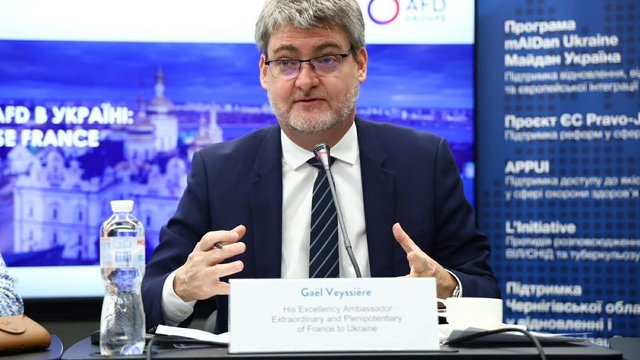
Exclusive interview with the Ambassador of the French Republic to Ukraine Gaël Veyssière for Interfax-Ukraine News Agency
In our recent conversation, France’s Ambassador in Kyiv described Paris taking decisive steps as G7 presidency in 2026 to shield Ukraine from Russia’s winter energy attacks, personally highlighting the swift dispatch of generators and France’s lead role in rallying G7+ support. He emphasized that military backing remains rock-solid — designed to give Ukraine real leverage in any future talks. The ambassador made it clear: France is not just delivering aid today; it is investing in a future where Ukraine can dictate its own security and reconstruction on its own terms.
Text: Valerie Proshchenko
- There was an urgent coordination meeting of the G7+ on Ukraine's energy situation. Several decisions were announced: EU sends emergency generators to Ukraine as France plans to coordinate aid. What direct, practical assistance will France provide to Ukraine's energy sector? When exactly will the first batches of aid arrive? When are the next energy meetings expected?
France assumed the G7 presidency on 1 January, and for us it was particularly important — as chair — to respond swiftly and concretely to the urgent appeal from the Ukrainian authorities following Russia’s most recent large-scale attacks on Ukraine’s energy infrastructure.
That is precisely why, last Friday, Jean-Noël Barrot, France’s Minister for Europe and Foreign Affairs, co-chaired — together with EU Energy Commissioner Dan Jørgensen — an emergency session of the G7+ Energy Coordination Group. It was essential for the Minister to be present and to help deliver tangible support at this critical moment, and I believe we managed to do so effectively.
France, for its part, is providing over 100 generators with a total capacity of 13 MW; with the first batch due to arrive already in the first week of February. At the same time, contributions are coming in from many other partners as well.
As Prime Minister Yulia Svyrydenko has noted, the partners announced and confirmed the provision of new support packages, which include more than 6,000 units of large energy equipment and contributions to the Ukraine Energy Support Fund.
Even with many other pressing international discussions taking place — whether in Davos, Abu Dhabi or elsewhere — the G7’s ability to respond promptly and substantively to Ukraine’s immediate needs remains of fundamental importance. Minister Barrot, who has visited Ukraine three times already, including brave cities like Sumy and Kharkiv, is personally committed to keeping this issue at the top of the agenda and to ensuring that our collective response matches the scale of the challenge. For France, this remains a very high priority.
Should we expect another G7+ energy meeting soon, or you don’t know yet?
We don’t have a date set yet. But of course, there are regular meetings in this format. And we can always convene an extraordinary one, like the one we just had.
For France, Ukraine is very important throughout our G7 presidency. We’ve already decided that we will invite President Volodymyr Zelenskyy to the G7 leaders' summit, and so on. But beyond that, we want to stay very focused and dedicated to the energy sector.
So, everything the G7 can do to support Ukraine, the French chair will be strongly committed to pushing it forward.
Did you receive any specific additional requests from the Ukrainian government regarding winter support?
Well, of course, there are many different requests coming in. They include spare parts, generating units to produce electricity, backup generators that can step in if the grid fails or there’s an outage, repairs to the grid itself, and funding to buy the necessary equipment as quickly as possible. All of these are being taken on board. The needs are enormous, and it naturally takes time to deliver everything, but I think everyone can see just how critical and urgent this is.
It’s simply unthinkable - in the middle of Europe, with temperatures dropping to minus 15 or minus 20, for so many people to be left without heating. It’s a terrible situation. That’s why I believe everyone is stepping up to contribute.
In fact, during this latest meeting, the United States also made an important contribution.
The European Commission, the EU institutions, and all our other partners are actively involved as well. So overall, this is a powerful demonstration of political will and solidarity — and that’s exactly what we need right now.
Can you mention the specific amount of money, for example, that France has already given to Ukraine’s energy sector?
Since 2022, the French government has provided 94 million euros to Ukraine in the field of energy, 87 million of which are direct bilateral aid.
When we talk about France, for instance, those more than 100 generators include 30 that are fully financed by the French Ministry for Europe and Foreign Affairs, and 69 other financed by the French state. But there are also generators funded by NGOs, and we may have additional efforts that aren’t even fully accounted for yet - because local authorities are still working on them. For example, the City of Paris is actively considering a very significant contribution to support Ukraine’s energy sector.
On a personal note, last year I went to Kharkiv with some generators myself. We also sent generators to Chernihiv, and there were deliveries to Kyiv - including some provided by French companies. It’s all very diverse, and it’s challenging to keep track of every single initiative.
Returning to France’s G7 Presidency - as you mentioned, Ukraine is one of the most important topics. Can we say that it’s a central priority for your presidency?
Yes, Ukraine will be a very key topic for our presidency. Absolutely.
And how do you plan to balance that with the new U.S. position?
We engage with our partners, obviously - and that includes the United States. There will definitely be a major G7 Summit this year. It’s scheduled for Évian in June. But June is still quite far away, so it’s difficult to predict exactly what the situation will look like by then, especially as the peace process is actively moving forward.
But absolutely, it’s important to us that the G7 plays a role in supporting peace efforts - but a sustainable, just, and lasting peace.
How do you assess the first direct meeting between the Ukrainian-Russian delegations, mediated by the US, in Abu Dhabi?
There were discussions in Abu Dhabi, and I very much hope that new talks will take place quite soon. Importantly, though, these should also include the Europeans at the table.
Europeans - and Europe as a whole - are ready and able to contribute a great deal to Ukraine, especially within the framework of any peace process, ceasefire, or eventual peace agreement. We are actively preparing substantial packages in several key areas: security guarantees, the possible deployment of a multinational force, and a major economic reconstruction plan. All of this is being worked on very intensively right now.
But of course, to make these contributions fully meaningful and effective, we must be present at the negotiating table.
On the other hand, these negotiations are taking place against the backdrop of intense and ongoing air attacks…
It’s undoubtedly a major challenge. These attacks are particularly shocking because they directly or indirectly target civilians — often by striking energy infrastructure and leaving entire communities without heat, power, or essential services in the middle of winter. We deeply regret this.
Nevertheless, there is an active political and diplomatic process under way, and the fact that it is moving forward is, in itself, a positive development. We fully support Ukraine’s willingness to engage in these talks and to work toward finding a solution.
What stage is the Coalition of the Willing currently at? I mean, in January, “strong” security guarantees for Ukraine were agreed upon in Paris, and a declaration was signed. So what now? A continuation of technical consultations?
All these groups are actively working right now, holding discussions and so on. As you know, in diplomacy, there is typically no agreement on anything until there is agreement on everything. The idea is therefore to have a full package. Within this package, one of our top priorities was to define what security guarantees for Ukraine could look like — so that Ukraine can build on them and know they are solidly in place.
Of course, if you start by saying, “Okay, don’t do this — let’s first agree on territories,” which is obviously the most difficult issue, then everything becomes even harder. That’s why we insisted so strongly: “Let’s begin with the security guarantees.” And that’s exactly what the Coalition of the Willing has done.
Now you have several layers of security guarantees from the Coalition of the Willing, including support for the Ukrainian army, the possible deployment of troops in the framework of a ceasefire, and broader assistance. There are also specific U.S. security guarantees currently under discussion with Ukraine. Our understanding is that all of this is robust and moving forward.
We believe the significant progress made - especially during the Coalition of the Willing summit in Paris on January 6th, with the participation of the Americans (Mr. Kushner was there) - is actually helping advance the whole package. Of course, the package also includes reconstruction.
But despite all the technical discussions, will France and Britain definitely and really send troops to Ukraine?
It’s quite clear: we will be ready as soon as the conditions are met. The first and main condition is a ceasefire, and of course, there would need to be a formal request from Ukraine.
Right now, we are genuinely ready. There is already a very robust military framework in place - covering land, sea, and air. The agreement signed in Paris on January 6th between Ukraine, France, and the UK precisely defines what that support would mean and how it would work. So we are nearly ready - in fact, as soon as the conditions are met, we would be fully prepared to act.
The issue now is not our readiness; the issue is how to move forward. The United States is also contributing through its own form of security guarantees to Ukraine. Overall, everything is in very good shape on that front.
The remaining question is whether Russia is really determined on agreeing on a sustainable peace. For us, the position is very clear: we are here to support Ukraine and to create the best possible conditions for Ukraine to negotiate. Ultimately, Ukraine is the one that negotiates — because it’s your territory, your people, and you are the ones bearing the full impact of this terrible war.
But what if the Russians, for example, say: ‘No, there will be no international troops on this territory, and we don’t need Europe involved here,’ and so on? Would Europe simply accept that?
Russia doesn’t have the right - or the legal basis - to dictate terms to a sovereign country like Ukraine. If Ukraine decides to invite allies onto its own territory, that’s entirely its sovereign choice. There’s no valid legal reason for Russia to object.
Where it does get complicated, of course, is that Russia could respond by saying: ‘Fine, but if that happens, we won’t agree to a ceasefire.’
In that case, they would have to accept responsibility for blocking progress - and for showing that they’re not genuinely interested in ending the war. These are precisely the kinds of difficult issues that need to be addressed and that includes direct discussions between Ukraine, Russia, Europe and the United States.
Going back to the historic agreement on military cooperation signed between President Macron and President Zelensky. As our President stated, “Ukraine will be able to receive 100 Rafale fighter jets and very powerful French radars — eight SAMP/T air-defense systems, each with six launchers.” Could you share some information on when and what could be delivered, particularly regarding the SAMP/T?
I cannot provide specific figures, as those numbers are not public. Releasing them would make the information available to everyone, including Russia, so we keep them confidential.
Intense work is ongoing.
So, no specific information, I understand
Yes, indeed. But you know that we have already delivered some other equipment. We have provided Mirage aircraft, which are already operational and being used effectively by Ukraine. We have also supplied SAMP/T systems, ammunition, SCALP missiles, CAESAR howitzers, and more. We are trying to do a great deal while staying as closely aligned as possible with the actual needs of the Ukrainian armed forces.
And if I’m not mistaken, you began supplying the Mirage about a year ago. Can you say how many batches have already been delivered?
No, we don’t communicate those numbers.
Okay, but deliveries are still continuing?
Of course, the program is ongoing yes. And the training of pilots - that program is ongoing as well.
I also have to ask about the SCALP missiles. There have been reports of shortages.
It is true that we don’t have huge stockpiles of them, and they take a long time to produce, for obvious reasons. But we are doing what we can.
And France’s position remains firm: more weapons to Ukraine so it can fight and protect itself?
Of course. We need a strong Ukraine - including militarily strong - so that Ukraine is in the best possible position, including when it comes to negotiations.
But you have no plans to participate in the PURL initiative?
Well, no, France is not participating in PURL. We are focusing on other avenues of support. For example, when we provided Mirage aircraft to Ukraine, that was done outside the PURL framework - but I think it was still very significant and valuable.
The PURL mechanism itself can certainly be useful for Ukraine, especially when it comes to acquiring certain U.S.-made military equipment that isn’t produced — or isn’t produced in sufficient quantities — in Europe, such as Patriots or Patriot missiles/ammunition. That’s why, in the European tools and funding mechanisms we are putting in place, we naturally want the largest possible share of European money to go toward financing European-made equipment for Ukraine.
At the same time, we understand that if there are shortages or critical items that Europe simply cannot provide, and if those items are key for Ukraine, then we need to find ways to make them available. There are other European channels for that.
But to be clear: France is absolutely working on strengthening Ukraine’s air defense - right now, actively and continuously.
And regarding drone production, the former minister, Sébastien Lecornu, who is now the prime minister, announced earlier that some French companies would produce drones together with Ukraine. Is this process still ongoing?
Yes, it is an ongoing process. It hasn’t fully started yet in terms of production and where, but preparations are advancing steadily, and the picture is becoming clearer by the day. There should be additional exchanges and steps forward in the near future.
This is actively continuing. At the same time, we’re pursuing other related initiatives. For example, when President Zelenskyy visited Paris in November, a major meeting was organized specifically with drone manufacturers from both Ukraine and France to exchange expertise and explore cooperation.
More recently, when Deputy Minister Alice Rufo was in Kyiv on Friday, this topic was also discussed with Deputy Minister Boev from the Ukrainian Ministry of Defence. So yes, we are definitely working on this. In fact, some French companies are already active in the drone sector in Ukraine
Yes, and one last short question: Is there any possibility of Russia returning to the G7 - G8 format?
Well, not at the moment - obviously. What everyone expects from Russia, first and foremost, is that it ends this terrible war in a way that is acceptable for Ukraine. As long as the war continues, and as long as Russia keeps behaving the way it is - including these relentless strikes on Ukraine’s energy grid and civilian infrastructure - there is simply no basis for any such discussion. It makes no sense at all.