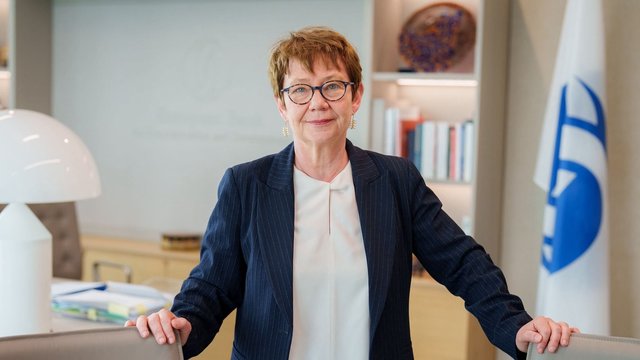
A сonversation with the President of the European Bank for Reconstruction and Development (EBRD) Odile Renaud-Basso.
Text: Dmytro Koshovyy, Mariia Boltryk
— What do you think is the main result of your meetings this time in Kyiv? We read about your meetings with the head of NBU Pyshnyy, president Zelenskyy, Prime Minister Serhiy Koretsky, Minister of Energy Denys Shmyhal, Minister of Economy and Environment Oleksandr Kravchenko.
— Yes, we had a lot of meetings. I think for us, first of all, for the EBRD, Ukraine is very important. We have invested almost EUR11 billion since the beginning of the war. So it’s very important. We plan to invest around EUR 2.7 billion this year.
The core of the discussion was the priorities: to discuss the situation, where are the needs in the state on everything related to the state sector, key infrastructure and so forth, the priorities, implementation issues. When you invest such a large amount of money, how do you know how to accelerate implementation and be as efficient as possible?
We had a very good exchange. A lot of what we do is also in the private sector. This year, we expect that 80% of the financing will be in the private sector. We meet clients to understand the project, the situation, some banks and other partners.
For now, we see that many discussions are focused on winter preparation. Where do we stand on the preparation for winter? What can be done? What are the new risks emerging from the escalation of Russian pressure on Kyiv, those kinds of issues.
Also, the reform agenda, because we work a lot with state-owned enterprises and in a number of sectors we are supporting reform, for example, reform of the state governance of state enterprises, board composition, appointment, the role between the board and the government.
— Do you see some improvements in corporate governance after the last scandal?
— We see some. It sometimes has good progress and sometimes experiences some backtracking. It’s a bit uneven.
And in the last few years, it’s been uneven, but we see some progress. For example, the board composition in a number of companies is now built up in a professional manner with external advisers, recruitment specialist committees to decide on appointments and so forth.
We see some progress in Energoatom, which was one of the companies where the governance was probably the most problematic. There are still some important decisions that should be taken.
This is also important for Naftogaz, but the process seems to be well on track.
— You talked about this year, but what about next year, 2027? What is the financing planned for?
— So far, as we are demand-driven, we depend on the projects that we see. It depends on the demand for investment from private-sector clients and so forth, so it’s difficult to say. I think our capacity to invest will be of the same order of magnitude.
But we need to see whether our clients invest or need working capital and support.
What will be the bank appetite? We have a lot of activity that takes the form of portfolio risk-sharing, where we cover part of the risk of the banks.
Bank lending has been increasing quite significantly in the last few years. This was a driving factor for our portfolio risk-sharing.
What will be the behaviour of the banks in the new economic environment is uncertain, but more or less in the last few years our activity has been increasing. Now we are remaining around this level. We hope that this will be the case.
In the public sector, there is a lot of investment needed. But state enterprises face some limitations in how much they can borrow and how much they can pay back. So there is some investment in fact. We need some external guarantee and external donor support to be able to continue to invest.
— What change might be made to the strategy and tactics of the bank in this new stage of war escalation?
— Our tactics will remain unchanged: to be very agile.
Of course, as a bank, we also look at our own risk, how we can cover our risk, and what kind of risk. This will remain in the background in how we take our decisions.
But there is no big change of tactics that I see coming, maybe a change of priorities. What we’ve been very agile about, when you look at the past, is how we supported the energy sector when confronted with attacks in the last few years.
Now, I think, with the current situation in the Black Sea, there is renewed interest, for example, to focus on how to ensure that the railway, the roads connecting Ukraine and Europe, either to Poland or Moldova, function well.
So that could be a change of what kind of investment becomes priority investment, but I don’t see a change of tactics for the bank.
So it will remain supporting Ukraine, balancing our risks by taking risks that are palatable for us and that do not challenge our financial strengths, so working with donors in order to mitigate risk and support investment.
— Recently, the EBRD downgraded the forecast of GDP this year to 1.5%, but unfortunately the Ukrainian government and the National Bank (NBU) now see near 0.5%. Independent analysts, for example Dragon Capital, said it’s near 0% or maybe even negative. What’s your view? Do you see a new downgrade?
— I think that we see the economic slowing, really clearly, since August, with the intensification of the strikes on economic infrastructure.
So it used to be mostly energy, but now it’s also ports, the port blockage plus the Black Sea blockage plus the attacks on logistics, on warehouses, on manufacturing capacities and so on.
So this has a very negative impact on the economy. So I think the central bank, for example, has made some different scenarios.
What I could say is that we still see more downside risk than upside risk.
— Maybe a few words about new projects? Yesterday I read about a new one, the stabilization of the balancing electricity market. The total funding requirement is approximately EUR 600 million. What’s the part of the EBRD?
— So this is a big, important decision we are having with the Minister of energy and the government, because I think they are really willing to implement this very important reform, which would have a very strong impact on the market. It’s really a structural reform, which we would very much welcome. It’s a complex project.
I think our part of financing would be co-investing probably with other international financial institutions (IFIs).
It may still be very much in the making, but we could have something like a EUR150 million loan, another IFI doing another share, and then it would need some important funding on a concessional basis from the EU because part of the debt will never be recovered, so it can not be financed by debt.
— What other systems can the bank offer to address the challenges of the logistics of Ukrainian exports? Is there ane project of developing new roads?
— We are doing logistics. We have signed a project with financing to Ukrzaliznytsia (Ukrainian Railways - UZ), we had elocate targeting more energy generation projects. Now, because they have been under attack and need working capital, we reallocated EUR 130 million to give them working capital.
We also have a big project worth EUR300 million which is being implemented to buy locomotives. And it’s very much needed because a number of them have been damaged, so that’s one important way in terms of logistics.
The other one is indeed that we have some broad project: we are working on a road project. We are discussing the priorities in this area.
The third element is that we put in place, with local insurers a mechanism to guarantee war-risk logistics in the transport of goods in Ukraine. We have already covered the EUR500 million worth of goods. It’s working quite well, and this is a mechanism that we are working to extend a bit so as to be able, for example, to guarantee what is stored in the warehouse.
— But Ukrzaliznytsia is now in default, Ukrenergo is now in process of restructuring the eurobonds. Isn’t it a problem for you?
— It’s always a problem. It’s never very comfortable to lend to a company which is in default or in restructuring... But, on the other hand, they have always been paying us on time, which is very important because of our multilateral status. To provide money, they need to pay us.
It reflects the financial constraint. We were very supportive of two measures that have been taken by the government, which were really needed in order to help Ukrzaliznytsia to rebalance its situation, and this is the PSO. So the compensation by the government for the PSO. And the second is a freight tariff increase. It’s not a very popular decision, but it’s very important. At some point, you need to have the company able to have revenues to deliver the service.
— About the war risks. The business is calling for help with insurance issues but opposes tax increases. Could the EBRD help in this situation?
— As I was saying, we’ve already developed a targeted product because we believe it’s extremely challenging to cover it. So we really focused on transport because there was really no market at all. We have also developed some projects with our banking portfolio.
This was done on a pilot basis, but we are looking to scale it up to include the possibility, when the loan finances an investment and the investment, for example, a new facility, is destroyed, to reduce the debt repayment and take into account the fact that there has been a loss.
So this is an Enterprise Security Enhancement, what we call ESE, the name of the product. And this is a bit like war insurance, but because it reduces the debt that you have to pay back.
This is something we try to develop to adjust our tools, our toolbox, to the needs of the clients and the economy.
— The increasing of tax - is it a critical condition for you, for the EBRD, or other IFIs to take part in this new insurance fund? Because as for now, it’s a very difficult discussion is going on in business.
— I don’t think we are going to take part in the insurance fund as such, because we are a bank, so we cannot finance an insurance fund which is for compensation, because we have no money. We need to pay it back. As a bank, we need to be paying back.
So we have been having a discussions, and we continue to have discussions on what kind of scheme is the most effective, what the solutions are in view of the situation and so forth.
But I believe indeed they need to have a mechanism of compensation by the government. You need some funding and the resources are very scarce. But it’s not up to me to make a judgment or decision whether they need to increase tax or not.
— Another question about the attraction of strategic investor to the new infrastructure holding on the capital markets. Unfortunately, again, we have an internal discussion in Ukraine between the NBU, the Securities Commission, some PMs, and we have an alternative law. The head of the National Bank said he is asking for your help in this dialogue. For example, for our news agency, this is a very important project, because it’s hard to survive without capital markets and investors.
— We agree with you that it’s a very important project for the future because when the economy reconstructs and bank lending will not be enough. So companies will have to access capital markets and so forth. That’s why we initiated this work with the central bank and with the Securities Commission and all the players. Really to study what would be needed in terms of vertical integration. I think the idea is really to integrate the different infrastructure in order to make the system more efficient and then possibly to attract a strategic investor in this and to boost the market.
And so we were very much working hand in hand with the NBU to prepare a tripartite MOU with the NBU, the Securities Commission. It was on the Ukraine Recovery Conference (URC 2025) in Rome. So the MOU, designing the commitment, preparing them as a milestone to prepare the law. We are actively explaining it’s quite a technical issue to the Rada members who are interested in this project and who will participate in the decision-making: what is the whereabouts and what is what we expect as an impact.
— Because today the Commission wants at least two candidates of big strategic investors for this holding. As for me, if we have one strategic investor, it will be a big victory.
— At least. So it would be an open process. People, I think that we’ll see who comes.
— Are you ready to invest in the Ukrainian defense industry?
— As we are a development bank, we do not invest.
We do not invest in defense, because we have a lot of shareholders with very different positions. Sometimes they don’t get along too well together, so there are some tensions. We do not invest in military equity.
— We are talking about the dual-technology, because in the press release of Ukraine`s economy ministry there are a few terms, where are the red lines?
— We are doing a study on dual-use business, to have a picture of what it’s doing and so forth. There may be, for example, when you think about drones. There is a huge military use, but it also could be used for completely civilian things like agribusiness and others.
We need to figure out. We have the capacity to invest in dual-use, but it’s quite restricted. What is the share of military, what is the share of civilian?
But, I mean, that’s something we are exploring to see also what will be the role in the Ukrainian economy in the future, what is the structure of the business because it’s very new. And maybe there will be some opportunities, we will see. The study will be done in few months. We want to present the findings at the URC in Tallinn at the end of January.
— Is the winter URC is a good decision for you?
— And I think it’s too close to the previous one. I think it’s a bit because there have been a lot. The URC is helpful for coming up with a deadline. Now it’s very close.
— About new safety confinement. We are looking forward with great hope to the Donors’ Conference in Paris this November. I know that the need amounts to about EUR 500 million. How much does EBRD plan to raise at this conference?
— Hopefully, EUR500 million. Hopefully, that’s our target. We are ambitious and need to have the funds. We would like to be as close as possible to the EUR500 million, because it’s a question of safety.
And we already have some commitments which are around half of it. The U.S. has committed to providing $100 million. We already know that there will be additional.
The work needs to start in 2028. I think it’s very important.
— Do you have any actual information about the situation on the nuclear station?
— Because of the war there had been some fire, so the whole protection cover has been really damaged. So there had been a very temporary sort of protection system put in place, but it doesn’t protect against humidity and the risk of corrosion and so on. It’s not an immediate risk for radiation, but it’s more if nothing is done, then you have this nuclear reaction still going on under the shelter, I mean, under the confinement.
And everything has been built in order to be able to manage this reaction with equipment without human intervention, and all this system which has cost EUR 2 billion and has been built with a lot of international corporations.
Of course, if it becomes useless, we’ll have to build something completely new. It would be much more expensive than repairing it, even if repairing is already quite expensive. We should do it now. The whole structure will have to be reconstructed, and the whole equipment that is below the structure, within the structure, will have to be reconstructed.
— Maybe some thoughts about municipalities. You have signed a EUR150 million agreement with Kyiv regarding the metro. What are the municipality projects now in the bank’s portfolio? How important are the municipality projects for you?
— It’s important, and we’ve done projects with Lviv on transport resilience. And we have projects in Kharkiv, in Dnipro, in Ternopil and in Kyiv.
And so municipalities are very important players with important responsibilities in transport, energy, and water management. We have been focusing on this.
We also provided emergency liquidity support to Kyiv last year when the CHP were under attack in order to help them with repair, rebuild and so forth.
Overall, I think before this new loan, we financed EUR300 million of projects in the municipal sector. So now this one is EUR 150 million. It’s quite significant overall.
— I asked you about red lines, but now we have a blue line, Dnipro river, and unfortunately some companies said that we invest only on the right bank of Dnipro. Some companies are saying that they invest only in the 35 region near the west border. Do you have some geographic restrictions for your bank?
— We have a map which shows that we have projects very well spread across Ukraine.
Of course, a lot of business are here, in Kyiv. But also we have some renewable investment or business partners in different parts of the country, so it’s quite well balanced.
— But Dnipro is almost on a frontline?
— Dnipro and Kharkiv, yes. They are two of our best municipal clients, so we have large funding for them. We have private-sector projects on the front. We have all of our projects, municipal projects, quite spread out.