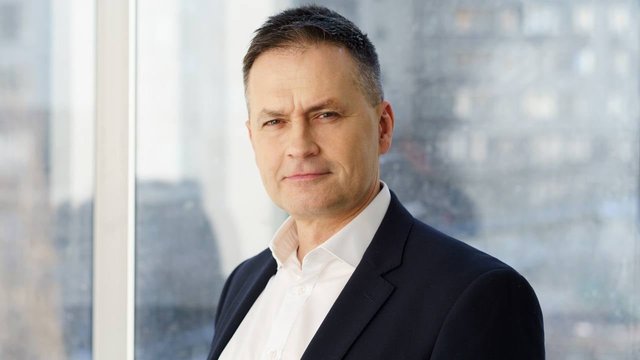
Interview with Viesturs Liegis, Managing Partner at Amrop, Baltics and Ukraine, for Interfax-Ukraine news agency on the formation of supervisory boards at state-owned companies, the Sense Bank selection process, and foreign business interest in Ukraine
Text by Serhii Korkhmazov
— How long has Amrop been operating in Ukraine, and what was your first major assignment here?
— The Amrop office in Ukraine was effectively relaunched in 2015. Until 2014, Ukraine within the Amrop structure was managed from Russia, but after that the group’s global management ended the Russian team’s oversight of Ukraine and offered us, the Baltic team, the opportunity to take over the Ukrainian licence. And in 2022, the Moscow office was completely excluded from Amrop.
I myself have been with Amrop since 2005. I am from Latvia, and we have been developing the group’s Baltic structure. In 2015, we created a new Ukrainian office practically from scratch.
Amrop is a global company, with around 70 offices in 60 countries. We are particularly well represented in Europe, including Eastern Europe, and there is very close cooperation within the network, which allows us to attract strong candidates from different markets.
Our first major project for PrivatBank was in 2017. It was not a supervisory board selection, but a search for a CEO and CFO following the bank’s nationalisation. Petr Krumphanzl became CEO at that time.
After the nationalisation, the bank was run by interim management for some time, after which a search for permanent management was organised.
For us, this was a very important project. It was a difficult period because of the litigation with the bank’s former owners, and given his profile, Krumphanzl was someone who could withstand that pressure.
After Krumphanzl, the bank’s management changed, but the subsequent search was no longer our project.
— How many projects involving the formation of supervisory boards of Ukrainian state-owned companies have you completed?
— In total, we have completed 11 such projects.
The first structured project to form a supervisory board was Ukrposhta in 2018. Supervisory boards had also been formed at state-owned companies before that, for example at Naftogaz, but it was not yet such a structured competitive process.
In the Ukrposhta project, drawing on global experience, we introduced a number of methodologies that later became standard for other selection processes. For example, assessing candidates against a competency matrix. It is no longer an approach of “good person or bad person,” but a detailed assessment of whether someone meets specific requirements.
— What is the role of a recruitment company in such selection processes in general? Do you actually choose the candidates, or do you only recommend them?
— It is important to distinguish between the two. An executive search company acts as an expert, while all decisions are taken by the nomination committee by majority vote.
We attract candidates, assess them, and provide our conclusions and recommendations. But the nomination committee can remove someone from the shortlist we recommended or, conversely, ask us to assess other candidates from the overall pool.
And that is entirely legitimate.
The selection processes themselves are public, meaning that essentially anyone who meets the requirements can apply. But in our experience, if the executive search company does not actively attract strong candidates itself, including people who did not initially plan to participate or were unsure, the result is often weaker. So one of our key functions is to persuade strong candidates to apply.
— How did the selection process for the Sense Bank supervisory board take place?
— A total of 111 candidates applied. Under Ukrainian rules, we are required to assess all candidates who apply and meet the formal requirements.
Of the 111 candidates, two submitted their documents late, so we could not consider them. The rest were assessed against the competency matrix approved by the nomination committee.
As a result, we formed a shortlist of 29 candidates for six seats on the supervisory board. Each seat was intended to correspond to a particular set of competencies, so that the board as a whole would ultimately be balanced.
— How many candidates for the Sense Bank selection process did Amrop attract itself?
— I do not remember the exact figure anymore, but roughly 21–22 of the 111 candidates were people whom we ourselves persuaded to apply.
The rest applied on their own.
— Who conducted the selection process to choose Amrop itself for the Sense Bank assignment?
— De facto, the process was conducted by the Ministry of Finance as the bank’s owner. Formally, the contract was with Sense Bank, but the decision was made by the ministry.
As I understand it, the Ministry of Finance is not required to run such selection processes through the Prozorro system. They collect proposals and choose the consultant themselves.
We already had experience working with the Ministry of Finance. In particular, we formed the current supervisory board of PrivatBank at the end of 2022. At the time, the ministry said that, in its view, this was one of the best projects of this kind.
— You said at the Temporary Investigative Commission meeting that Mykola Hladyshenko was not on Amrop’s initial list of recommended candidates. How did his candidacy enter the process?
— We were told: there are some additional candidates, please provide your assessment.
So it was a parallel process. We had already done our work and formed the shortlist, after which the nomination committee asked us to assess several more people. Hladyshenko was one of them.
This was entirely legitimate. The nomination committee had the right to do that.
— Who exactly approached you with the request to assess additional candidates?
— Iryna Mudra was the chair of the nomination committee, and we were in regular working contact with her.
During one of those contacts, the request to assess additional candidates was made.
— So you assessed Hladyshenko and did not recommend him, but the nomination committee could still select him?
— Yes. We provided our assessment of the candidates. The decision was then taken by the nomination committee.
There were discussions, but ultimately the decision was taken by majority vote. Yurii Drahanchuk from the Ministry of Finance abstained.
Under the procedure Amrop does not vote. We act in an expert capacity and provide information, but we should not be directly involved in the decision-making. It is important for us to remain independent.
— Did you feel any pressure in this process, as if a particular candidate had to be supported?
— Formally, everything was within the procedure.
Of course, when you are asked to additionally assess specific people, it raises different feelings and questions: why these particular candidates, why is it happening in this way? But formally, the procedure was followed.
— Former Sense Bank supervisory board chair Sevki Acuner also reapplied in the selection process. Did you consider his candidacy?
— Yes, his candidacy was considered.
In his case, we drew attention to the fact that he was on the board of a Turkish company that had business in Russia. This was an issue that we brought up for consideration.
His candidacy needed to be discussed separately in any event. In fact, someone had previously failed to pay sufficient attention to this point.
— During the selection process, was there a discussion about the balance between Ukrainian and foreign members of the supervisory board?
— Yes. In this project, the chair of the nomination committee strongly insisted that there should be more Ukrainians.
In my view, this was to some extent used a means of exerting pressure.
— Why?
— Because there are more opportunities to put pressure on Ukrainians than on foreigners.
At the same time, I believe that strategically the goal of increasing the number of Ukrainians on supervisory boards is the right one. We discussed this with the IMF as well. The necessary competencies need to be developed within Ukraine.
I would set a goal that in three to five years, around half of all independent supervisory board members should be Ukrainians.
— Was Nataliia Dehtiarova among the candidates selected by Amrop?
— No. We do not work with state representatives; we select only independent members of supervisory boards.
At the same time, there is now a positive trend: the government wants to introduce assessments for state representatives on supervisory boards as well, so that it does not work on the principle of “this is my person, I will appoint them.”
We also discussed this possibility with the IMF last year.
— The candidates you selected earlier and who are now being invited again to join the Sense Bank supervisory board — are they still willing to do so after the entire scandal?
— Yes.
Of course, they conduct their own due diligence, review information from their own sources, and try to understand what is happening here. But they are willing.
Fortunately, we had a very strong initial shortlist. And the owner has now decided to fill the vacant positions with candidates specifically from that list.
One such candidate has already been approved — Peter Novak. There is one more position left, and I very much hope it will also be filled by a candidate from this list.
This is also part of our job — to stay in touch with them, communicate continuously, and explain the situation. To some extent, we are ambassadors for this system.
— Does this whole story discourage other strong foreign candidates from participating in selection processes in Ukraine?
— What everyone is watching now is how this situation will be resolved.
If there is a good outcome in the end, it will show that the system works: yes, a problem arose, there was a crisis, but it was resolved.
At the moment, we are focusing more on candidates from Eastern Europe — people who better understand the realities of the region and how quickly the world is changing.
But there are also strong candidates from Western Europe and other countries. For example, the chair of Energoatom’s supervisory board is from Canada and is very committed to change.
For work in Ukraine, you need to look for people who understand that this is not board work at an established company, where there is a meeting once a quarter and management gives a presentation. At Sense Bank, for example, you need to be ready to spend around 50 days a year — practically one day a week.
For professionals, working in Ukraine is very interesting now because, in a relatively short period of time, you can make major changes here, quickly see the results of your work, and use the experience accumulated over your entire professional career.
— Because of the absence of a fully functioning supervisory board, the bank has for some time been unable to resolve even staffing issues. How critical is this situation?
— The absurdity of the situation is not so much that a particular issue cannot be resolved. The main question is how a bank or company can function normally at all without an effective supervisory board.
Different parties may have different interests, but the system must ensure a balance between them.
— Does what happened around Sense Bank indicate a failure of the corporate governance system?
— I would say the opposite: what is happening in Ukraine now is a normal and, in the long term, positive part of the development of corporate governance.
If you look at the history of other countries, corporate governance has very often developed precisely through crises and scandals. After the 2008–2009 financial crisis, bank governance changed very significantly. The same happened after other major crises.
We have been working on this reform for about eight years, and the changes are very noticeable.
The problem is that we all emerged from the Soviet system and are accustomed to thinking in terms of a vertical power structure: somewhere at the top there is one all-wise person who will make all the decisions. But the system we are moving towards is based on checks and balances. There is no single all-wise person; the system itself must maintain the balance.
One of Ukraine’s major advantages, compared, for example, with the Baltic countries, is that the Ukrainian state is very open to international expertise. In many state-owned companies, supervisory boards include people with international experience.
— What needs to change in the system for forming supervisory boards of state-owned companies?
— One of the things we discussed with the IMF is the current principle under which the composition of a supervisory board is effectively renewed in full every three years.
I understand why this model was initially introduced, but we need to move away from it. If the entire supervisory board of a company changes at the same time, it is a major shock for the company. A new board may need six months or more to become effective.
It would be better if individual board members changed at different times, so that renewal is staggered.
Second, there is the assessment of supervisory board performance. There should be an annual self-assessment and, once every three years, an independent professional evaluation of the board’s work.
— What does such an independent evaluation mean? Is it similar to an audit?
— Yes, to some extent it is an audit. For example, we carried out such a project for Ukrgasbank at the beginning of last year at the initiative of the IFC.
This is not an assessment of the performance of the company itself. We look at how effectively the supervisory board works, whether it has all the necessary competencies, and how its internal processes are structured.
We also speak with management and shareholders because their assessment is important as well.
At the same time, there is always a question of conflict of interest if the recruitment company itself selected the members of a particular supervisory board.
— Are the current remuneration levels for members of supervisory boards of state-owned companies and banks too high?
— There are different approaches.
It is important to understand that the role of a supervisory board member at a Ukrainian state-owned company is very different from such a role in an established system. Here, board members sometimes have calls almost every day, resolve issues, and spend significantly more time and resources. It is no longer a classic non-executive format.
So I would not say that the current remuneration levels are necessarily inappropriate.
A better model could provide for a standard fee for a supervisory board member and additional compensation for major standalone projects. For example, the privatisation of Sense Bank will involve a great deal of work for the supervisory board: engagement with potential buyers, advisers, and much more.
But I also understand the risks of such a model: in an unusual situation, additional payments can create opportunities for manipulation. So it is simpler to establish a clear system.
In the case of Sense Bank, there are at least two additional factors: the future privatisation and the reputational risk that the supervisory board will also have to address. These should also be taken into account when assessing the scale of its work.
— Were there situations in other state-sector projects similar to the Sense Bank selection process?
— Projects are always different.
A good example is the most recent selection process for Energoatom’s supervisory board. There was a very clear task to form a new board by the end of the year, and everything was done very quickly.
There were many candidates and very tight deadlines, but in roughly six weeks we completed the project to the point where the new supervisory board could be announced.
With Sense Bank, it was the opposite. We submitted our shortlist at the end of February last year. So the process could effectively have been completed in March, but it dragged on until the summer.
— So can delays in a selection process themselves be a sign of problems?
— I think it is not simply a question of whether speed has a positive effect on transparency. It is an indicator in itself.
If someone is trying to delay something, that says a lot. Perhaps someone has certain intentions.
— After all these developments, does Amrop still plan to continue working with Ukrainian state institutions?
— Yes, of course.
We won all such projects through competitive selection processes. It is not the case that someone simply hands projects to us.
There have been cases when, for example, the Ministry of Finance asked us to help pro bono. One issue we are approached about quite often is remuneration benchmarking for supervisory board or management board members.
— What share of Amrop’s business in Ukraine comes from state-sector projects?
— Last year, state-sector projects accounted for 27% of our business in Ukraine.
So that is roughly a quarter. After the start of the full-scale war, their share was higher because private companies paused activity for some time.
And these are not only supervisory board projects. We are also engaged to recruit senior executives for state-owned companies and banks.
— How active is demand from the private sector now?
— We work with both Ukrainian and international companies. Metinvest, for example, is one of our important clients. In banking, we work with OTP Bank and Credit Agricole Bank.
For private banks, this is mainly top-management search.
An interesting trend is that, from around the summer of 2024, international companies already operating in Ukraine began resuming normal investment in their teams and development.
And since the spring of this year, we have started working with companies that are not yet present in Ukraine and are only considering entering the Ukrainian market.
— So foreign companies are beginning to enter Ukraine even before the war is over?
— Yes.
They understand that after the war ends, interest in Ukraine will be very high. And if you do not already have a presence here by then, it will be much harder to enter later.
Defence companies have already been operating actively in Ukraine for quite some time. But now companies from other sectors are also beginning to show interest and enter the market. I consider this a very positive signal.
— Has the intensification of Russian attacks changed this trend?
— Companies that are prepared to invest in Ukraine take a long-term view.
Of course, individual waves of escalation can affect decisions, but I have not heard anyone say because of the latest attacks, "No, we are leaving now," or completely abandon their plans.
— Amrop is currently searching for a CEO for Ukrainian Defense Industry. What stage is the selection process at?
— I would not like to disclose the details of this project at this stage. We are working on the shortlist.
We have a good working relationship with the supervisory board and understand each other well. It is a very complex project given the scale of the company and the current situation.
— Is it realistic to complete it by the end of the year?
— I think so.
— How large a market is Ukraine for Amrop?
— Ukraine is still a relatively small executive search market.
But its significance for the group is much greater than simply the amount of revenue. Everyone within Amrop is interested in what is happening here, and our partners in other countries help us with candidates and recommendations.
And we help them as well. For example, when working with defence companies, our partners in Sweden, Finland, or Germany can tell their clients that the group has a presence and connections in Ukraine.
After the war, the Ukrainian market will become much more interesting, and our strategic goal is to position ourselves so that by then we will be a significant player here.
— Has Amrop’s business in Ukraine already returned to its pre-war level?
— We are growing year on year.
It is quite possible that this year we will reach the 2021 level. We will see. Of course, after the start of the full-scale war, the decline was significant.