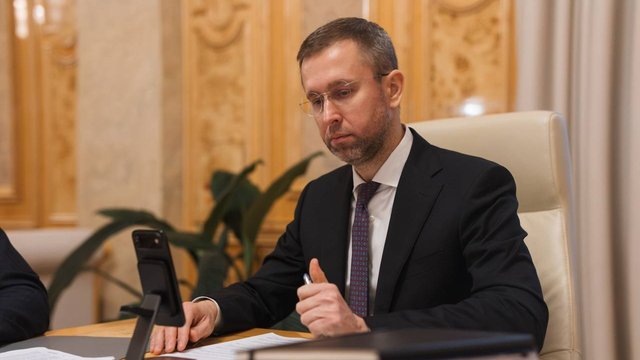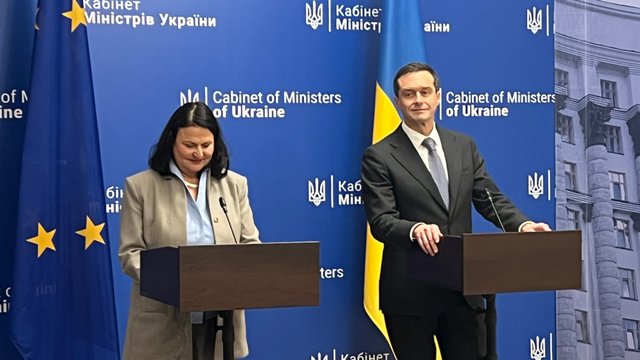
Ukraine's Deputy Prime Minister for European and Euro-Atlantic Integration Vsevolod Chentsov states that in order to carry out the reforms of law enforcement agencies necessary for European integration, it is necessary to strike a balance between ensuring their effective operation in wartime and strengthening institutional capacity.
"Here, I see only one possible path to achieving this goal – finding the necessary balance between ensuring that these agencies you mentioned, specifically the National Police and other law enforcement agencies, can effectively carry out their functions amid, unfortunately, ongoing aggression, and at the same time implement the necessary changes that would improve their performance and strengthen them institutionally," Chentsov said at a press conference on Wednesday in Kyiv, responding to a question about how the government plans to persuade parliament to speed up the reform of law enforcement agencies, particularly the National Police.
He said the government's cooperation with parliament will focus on this issue, and the right solution will be found.
As previously reported, on November 4, the European Commission released its annual enlargement report, which assesses where Ukraine currently stands on the path to European Union membership and outlines the next steps in the near term.
According to the report, Ukraine has made progress in all chapters of the negotiations. In particular, "significant" or "good" progress was noted in ten chapters: the free movement of goods, financial services, digital transformation and media, agriculture and rural development, energy, taxation, science and research, education and culture, the customs union, and foreign, security, and defense policy. The EU raised its assessment of Ukraine's readiness for accession in eight chapters: the free movement of goods, public procurement, financial services, digital transformation and media, taxation, the judiciary and fundamental rights, justice, freedom, and security, education and culture.
It is noted that if Ukraine implements reforms next year in the areas of the judiciary, democratic institutions, public administration, and minority rights, the European Council will be able to adopt an interim report assessing the criteria (IBAR – Interim Benchmark Assessment Report), which is a key condition for initiating the process of closing certain negotiation chapters.
European Commissioner Marta Kos noted that in the report, the European Commission proposes a new model of gradual integration on the path to EU membership for candidate countries. According to her, in the first quarter of next year, the European Commission will begin gradual integration dialogues with candidate countries to take stock of existing measures and explore further opportunities for integration.
In addition, Kos believes it is possible for Ukraine to receive an Interim Report on the Implementation of the Criteria (IBAR) as early as the first half of 2027 on its path to EU membership.
At the same time, the European Commissioner noted that the annual report does not specify a date for Ukraine's accession to the EU.
For his part, Prime Minister Serhiy Koretsky stated that Ukraine plans to receive a positive assessment of its progress toward meeting the interim criteria in early 2027, and in the first half of 2027, during Lithuania's presidency of the EU Council, it expects the preliminary closure of seven chapters.