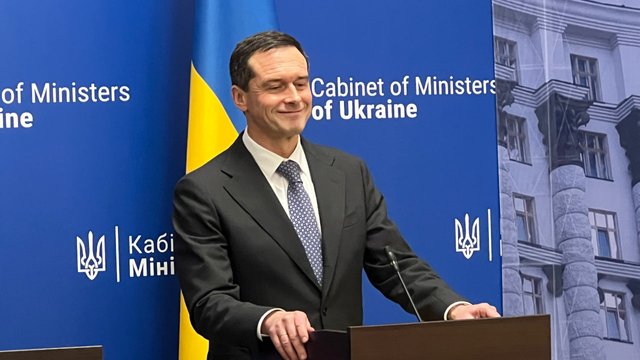
Ukraine's government expects to adopt most of the legislation across all chapters of the EU accession negotiations during 2027, Deputy Prime Minister for European and Euro-Atlantic Integration Vsevolod Chentsov said.
"There is a sequence of steps involved in obtaining a positive report, an initial positive report, on Chapters 23 and 24 (23, 'Judiciary and Fundamental Rights,' and 24, 'Justice, Freedom and Security'). And to answer the question, these concern justice and law enforcement reform. The next step is the provisional closure of the relevant chapters, which means adopting legislation across all areas of our work. At the government level, at least, we plan to organize this work so that most of the legislation across all chapters of the negotiating process is adopted during 2027," Chentsov said at a news conference in Kyiv on Wednesday.
He was answering a question from Interfax-Ukraine about which reforms Ukraine needs to accelerate to meet the ambitious goal of completing accession negotiations by the end of 2028.
He added that after this Ukraine would be able to receive an assessment from the European Commission and EU member states.
"On the basis of these conclusions, a draft accession treaty is prepared. That is the sequence of steps. So 2028 is, of course, a very ambitious but achievable goal for us. And everything depends on us," he said.
EU Ambassador to Ukraine Katarina Mathernova, in turn, said that the end of 2028 was a very ambitious target requiring Ukraine to maintain the pace of reforms seen since the summer, both in the Verkhovna Rada and in the government's work.
She stressed that the most important step was work on Cluster 1, "Fundamentals of the EU Accession Process."
"The remaining areas are sectoral chapters. Significant progress has already been made in many of them, but the Fundamentals are key. Every country has different approaches to organizing its healthcare, education and other systems. Even the Fundamentals can be organized in different ways. What matters is that these systems work effectively," she said.
Mathernova said she hoped that, given the current pace, including the Verkhovna Rada's readiness to adopt difficult and sometimes controversial decisions, completing the negotiations by the end of 2028 was entirely realistic.
As reported, on Nov. 4 the European Commission published its annual enlargement report, setting out where Ukraine currently stands on its path to EU membership and the next steps in the near term.
According to the report, Ukraine has made progress in all negotiating chapters. In 10 chapters, progress was assessed as good or very good: free movement of goods, financial services, digital transformation and media, agriculture and rural development, energy, taxation, science and research, education and culture, the customs union, and foreign policy, security and defense. The EU raised its assessment of Ukraine's level of preparedness for membership in eight chapters: free movement of goods, public procurement, financial services, digital transformation and media, taxation, judiciary and fundamental rights, justice, freedom and security, and education and culture.
The report says that if Ukraine implements reforms next year in the areas of justice, democratic institutions, public administration and minority rights, the European Council will be able to adopt an Interim Benchmark Assessment Report (IBAR). This is a key condition for launching the process of provisionally closing individual negotiating chapters.
European Commissioner for Enlargement Marta Kos said the European Commission's report proposed a new model of gradual integration for candidate countries on their path to EU membership. She said the Commission would launch gradual integration dialogues with candidate countries in the first quarter of next year to take stock of existing measures and explore further opportunities for integration.
Kos also said she believed Ukraine could receive an Interim Benchmark Assessment Report (IBAR) as early as the first half of 2027.
At the same time, the commissioner noted that the annual report did not set a specific date for Ukraine's accession to the EU.
Prime Minister Serhiy Koretsky, in turn, said Ukraine planned to receive a positive assessment of its implementation of the interim benchmarks in early 2027 and expected the provisional closure of seven chapters in the first half of 2027, during Lithuania's presidency of the Council of the EU.