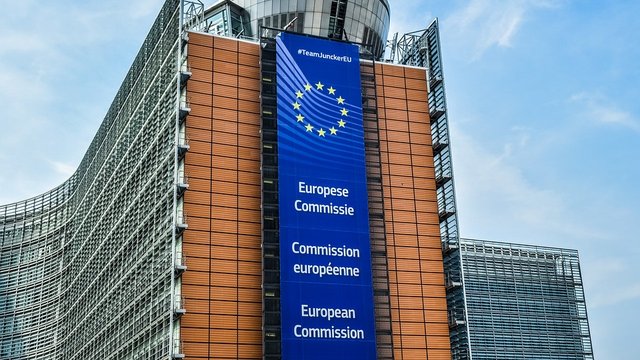
The European Commission has released its annual enlargement report detailing Ukraine's current status on its path to European Union membership and outlining the next steps in the near-term perspective.
If Ukraine carries out reforms in justice, democratic institutions, public administration, and minority rights next year, the European Council will be able to adopt the Interim Benchmark Assessment Report (IBAR), which is a key condition for launching the process of closing individual negotiation chapters.
The European Commission considers Kyiv's goal of completing accession negotiations by the end of 2027 to be ambitious, noting that achieving it requires a significant acceleration in the pace of reforms.
 The report notes that despite unprecedented security conditions caused by Russia's ongoing war of aggression, Ukraine has continued to implement reforms. In particular, anti-corruption institutions continue to operate independently and, overall, effectively, providing strong evidence of the depth of reforms carried out. Furthermore, significant progress has been achieved in several other areas.
The IBAR is critically important because it confirms the fulfillment of interim benchmarks in the fundamental field—democracy and the rule of law—and must be adopted before the process of closing negotiation chapters can begin.
The European Commission's position that the immediate next step for Kyiv is for the Council to open the remaining negotiation clusters by December remains unchanged.
The report analyzes the progress of 10 partner countries—Ukraine, Montenegro, Albania, Moldova, Serbia, North Macedonia, Bosnia and Herzegovina, Kosovo (a potential candidate country), Turkey, and Georgia—in the negotiation process, evaluating both the progress achieved and the overall level of readiness.
The package includes separate reports for each country, as well as a communication with strategic recommendations concerning enlargement policy as a whole. Additionally, one-year roadmaps starting from the current moment have been outlined separately for four leading countries—Montenegro, Albania, Ukraine, and Moldova. Specifically, for Montenegro through the completion of negotiations at the end of the current year, 2026; for Albania through the end of next year, 2027, when Tirana could also complete negotiations; and for Ukraine and Moldova covering the coming year, 2027.
On Wednesday, November 4, the European Commission is expected to announce that Montenegro has met all necessary criteria to complete negotiations and is ready for EU membership. It will likely transmit the final technical documents to the Council of the EU in the near future, possibly next week, for a final decision. For Montenegro, the negotiation process could be completed in December through the preliminary closure of all chapters. Following this, the accession treaty will be finalized in the spring and signed in June.
Regarding Albania, the roadmap notes that by the end of next year, it could reach the stage where Montenegro stands today. That is, Albania could also complete negotiations at the end of 2027, provided the current pace of reforms is maintained.
As for Moldova, interim benchmarks are expected to be adopted next year.
As is known, the last EU enlargement took place in 2013.