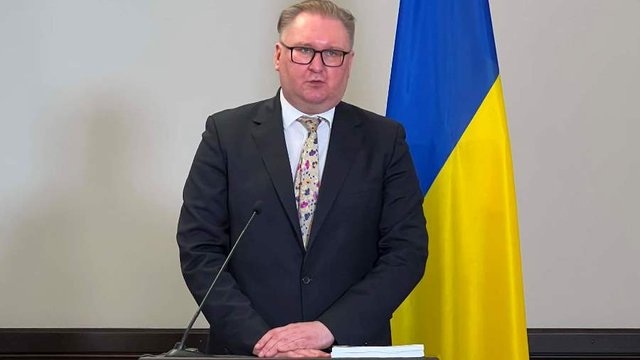
Ukraine's Representative to the European Union and the European Atomic Energy Community Taras Kachka, commenting on the meeting scheduled for November 4 in Abu Dhabi (the United Arab Emirates) between Ukraine, Russia and the United States at the team level, said he considered it important to resume trilateral talks on ending the war in Ukraine and hoped the parties would discuss a mutual cessation of strikes on energy infrastructure.
"This is good news. Do we have any very optimistic expectations? You know that all previous attempts have not been particularly successful. But we have had some limited successes, such as the ceasefire in Oleshky or the exchange of prisoners of war. So I think one of the topics to be discussed will be energy," he said during the special event "Support Ukraine, Defend Europe," organized by the newly established Kyiv Security Forum (KSF) Office in Brussels.
At the same time, EY-Parthenon Managing Director and former Ukrainian Finance Minister (2014–2016) Natalie Jaresko said she was convinced that "we should not believe that Putin is genuinely ready to sit down at the negotiating table at this stage."
Jaresko said that she did not have high expectations for these negotiations. At the same time, if we want to try to make progress, we must take steps now to increase pressure on the Russians, push Putin into a corner and make him believe that he needs to compromise, she said, emphasizing the importance of strengthening defense, sanctions and export controls.
Ivanna Klympush-Tsyntsadze, chair of the Verkhovna Rada Committee on Ukraine's Integration into the EU and a member of the European Solidarity parliamentary faction, also said she did not have high expectations for the meeting in Abu Dhabi. She stressed the importance of ensuring that "Europe is finally at the negotiating table, rather than somewhere on the menu of these discussions," since European security is at stake.
She said that an energy truce should be discussed as an immediate, top-priority and urgent step toward a ceasefire. But she said that she has no expectations that this will be the outcome of these negotiations.
DTEK energy holding CEO Maxim Timchenko expressed hope that U.S. President Donald Trump's call for an energy truce would "be received positively" during the meeting.
"And if not, that will give us the moral right to resume attacks on Russian oil refineries. Perhaps this is the only way they can understand that an energy truce is important not only for us but also for Russia. That is what I hope for," he said.
Head of Ukraine's Permanent Mission to NATO Alyona Hetmanchuk agreed on the need to secure an immediate ceasefire but emphasized the importance of working to strengthen Ukraine's negotiating position.
"We may now be in the best situation in terms of holding the front line and the situation on the battlefield; we are in one of the strongest positions we have been in throughout the full-scale invasion. But our vulnerability right now is our air defense, our skies. That is why we need our partners' help to strengthen our air defense capabilities. And that will automatically strengthen our negotiating position. Because without strengthening our negotiating position, unfortunately, as you know, we will be very vulnerable in these negotiations," she said.
Kurt Volker, former U.S. special representative for Ukraine (2017–2019) and a member of the Kyiv Security Forum's Security Council, also stressed that securing a full, immediate and unconditional ceasefire was the foremost priority.
Putin is not condemned often enough or loudly enough for his attacks and aggression against Ukraine, and he is not called to stop often enough. It should not be expected him to agree to this, but it could be spoken out much more loudly and in a coordinated manner: stop the fire right now, he said.
Regarding the U.S. position, Volker said he was convinced that U.S. President Donald Trump was currently focused exclusively on the midterm elections and that his position on Ukraine would not change.
Ukraine's greatest hope is the American people and the U.S. Congress. There is enormous support for Ukraine in the United States among a majority of supporters of both political parties and among a majority of the population. Legislative initiatives aimed at countering President Trump have been introduced. Republican candidates running in the midterm elections are being forced to publicly disagree with President Trump on issues such as lifting sanctions against Putin because the public views this negatively. So, in the long term, Ukraine has a strong base of support in the United States, the former U.S. special representative said.
As reported, talks in Abu Dhabi (the United Arab Emirates) between Ukraine, Russia and the United States at the team level are tentatively scheduled for November 4 this year. According to Ukrainian President Volodymyr Zelenskyy, the goal of the talks should be to make a meeting in a trilateral format at the leaders' level possible, as well as to discuss an energy ceasefire or a ceasefire in the Black Sea. The president also stressed the need for a meeting at the level of heads of state: "We should move from technical-level negotiations to a meeting of leaders, because key issues can be resolved only at the highest level."
The special event "Support Ukraine, Defend Europe" was attended by senior officials from the European Union, NATO and Ukraine. It was dedicated to strengthening support for Ukraine and joint European security. It was the first high-level event organized by the KSF Office in the EU, which began operating in Brussels at the initiative of KSF head and former Ukrainian Prime Minister (2014–2016) Arseniy Yatsenyuk.