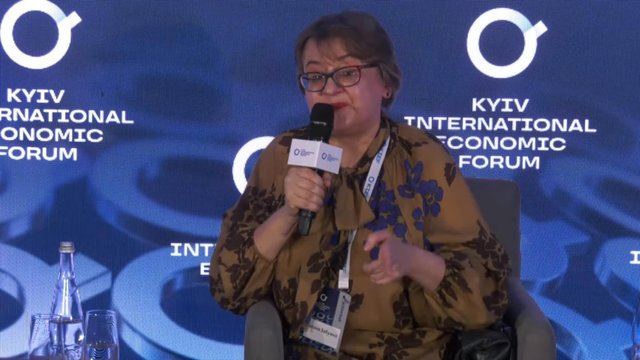
Ukraine was under information and cultural occupation in the decade between the 1990s and 2000s, writer Oksana Zabuzhko said.
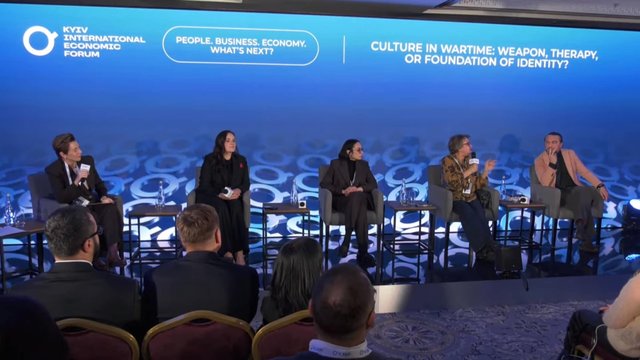
"In 1995, we had culture. In 2005, we no longer had it. We were a branch of the 'great Russian world,' which was engaged in the information occupation of Ukraine throughout the entire pre-war decade, starting around the turn of the 1990s and 2000s. This was the same preparation of Ukraine for co-optation into Russia, carried out on a massive scale and quite successfully in the information and cultural spheres. Accordingly, we were invisible to the outside world. The visibility of any nation is cultural visibility. As long as the political class does not understand this, this country will be condemned to struggle somewhere in the third ranks, among the countries of the Third World," Zabuzhko said at the 12th Kyiv International Economic Forum, themed "People. Business. Economy. What Next?", in Kyiv, answering a question about whether Ukraine had achieved a cultural breakthrough.
She said that before the full-scale war, no one abroad was interested in engaging with the culture of "some invisible country whose future was still unknown."
"But once our glorious armed forces gave a thorough beating in the spring of 2022 to those who were considered the world's second army, my dream finally came true. In October 2022, Lesya Ukrainka's Cassandra premiered to great acclaim at London's Omnibus Theatre," the writer said.
In her view, the most relevant definition for Ukraine today was one given by political figure Vyacheslav Lypynsky: "The sum of values that, in the course of a community's life, have proved most conducive to that community's survival is called culture."
"Motivation wins, spirit wins, and so does what the Ukrainian soldier has and the Russian soldier lacks. That is a cultural difference. It is a sense of defending the values of one's community. Ask our soldiers what they are defending: their home, their land. At the level of one's home, one's land and one's family, at this level of rootedness, we have already defeated the Soviet regime and Russia in what they wanted to do to our ancestors during the Holodomor," Zabuzhko said.
Returning to the notion of a Ukrainian cultural "renaissance," she stressed that an artist would succeed with a domestic audience only if they articulated the collective unconscious. That was when queues would form for cultural products, as had happened with the play The Witch of Konotop at the Ivan Franko National Academic Drama Theatre.
"The state's role is to obtain information from experts about this very wild-growing garden: where to graft and where to water, which areas need watering, and where to put in money and later recoup it, whether through the state budget, patrons or fundraising. That is an entirely separate matter. What grows on its own does grow on its own, as we have seen over the past decade. They introduced quotas for Russian music on FM radio, and suddenly it turned out that a great deal of Ukrainian music had grown wild in the meantime, having spent the previous decade being considered unsuitable for the format," Zabuzhko said.
As reported, Deputy Prime Minister for Humanitarian Policy and Culture Minister Tetiana Berezhna said that, given the vastly unequal resources available for culture in Ukraine and Russia, Ukraine needed to act asymmetrically. She also said there was currently demand among Ukrainian consumers for Ukrainian culture, demand among creators to produce it, and a need to introduce Ukrainian culture to international audiences.