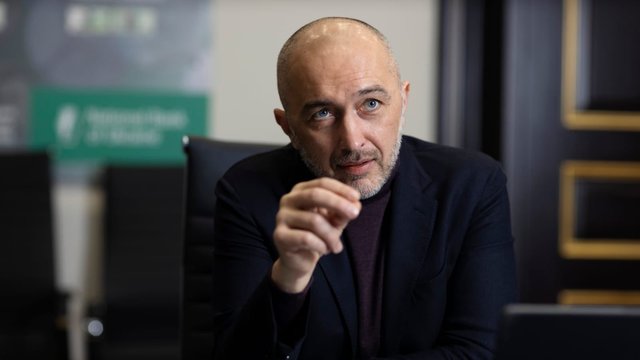
The issue of immobilized Russian assets is being discussed in the context of the need to find confirmed sources of financing to cover the "gap" in the state budget for 2027, which Prime Minister Serhiy Koretsky estimated at $32.6 billion at the Ukraine Ministerial Roundtable on October 14 during the Annual Meetings of the International Monetary Fund (IMF) and the World Bank, National Bank of Ukraine (NBU) Governor Andriy Pyshnyy said.
"Currently, the IMF chief [Kristalina Georgieva] has confirmed the need for assurances from partners regarding coverage of this 'gap,' which has been verified by the IMF. The IMF is also considering, in this context, the use of immobilized assets in a way that European partners would consider acceptable to them, in order to ensure that Ukraine receives the necessary amount of financing," Pyshnyy said in an interview with Interfax-Ukraine on the sidelines of the Annual Meetings.
According to him, the IMF always discusses this issue very cautiously, recognizing that its mandate and influence are limited.
"But the IMF is involved in discussions on the format for accessing immobilized assets. For example, the Fund may recommend paying attention to a factor such as debt sustainability, so that the use of immobilized assets does not create additional interest-rate pressure for Ukraine. As for how exactly this will be structured, that will be determined by the European bureaucracy," the NBU governor explained.
He said he was optimistic about the possibility of continuing to use immobilized Russian assets to finance Ukraine and mentioned the evolution of the IMF's and the European Central Bank's positions on the issue.
"This issue requires complex, comprehensive communication on the part of the president, the government and the National Bank. You have seen how many meetings I have had here: over these past few days, I have held dozens of discussions with partners. This issue remains one of our priorities," Pyshnyy said.
As reported, in 2024, the G7 established the Extraordinary Revenue Acceleration (ERA) mechanism, providing Ukraine with $50 billion in unconditional, non-repayable financing based on discounting future cash flows from the further investment of Russian assets immobilized in Europe, primarily at Euroclear, totaling approximately EUR 200 billion. Most of the $50 billion is scheduled to be disbursed in 2025–2026, while only $1.4 billion is allocated for 2027.
In addition, after the idea of a EUR 140 billion reparations loan for the EU backed by the same proceeds from frozen Russian assets fell through in autumn 2025, the EU developed the Ukraine Support Loan (USL), a EUR 90 billion mechanism for 2026–2027 to provide military and nonmilitary support to Ukraine. This is also non-repayable assistance to Ukraine; however, the allocation of part of the funding for budget financing is tied to Kyiv's fulfillment of reform conditions.
The 2027 state budget currently provides for $52.6 billion in external financing, of which only approximately $20 billion comes from confirmed sources. In mid-October, President Volodymyr Zelenskyy, taking defense spending into account, estimated Ukraine's total additional financing needs for 2027 at EUR 70 billion while in Brussels.
As part of efforts to secure these funds, according to available information, consideration is being given to launching ERA-2 and/or USL-2 mechanisms by continuing to discount future cash flows from Russian Federation assets immobilized for a longer period or investing them in higher-yielding assets.