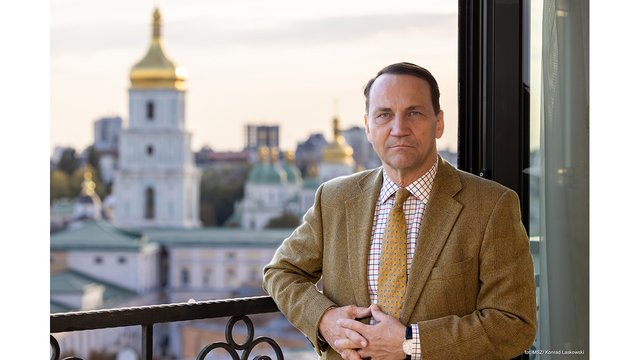
Polish Foreign Minister Radosław Sikorski has signed a motion to include Sviatoslav Sheremeta, a deputy of Lviv Regional Council, on the list of individuals whose presence in Poland is considered undesirable.
Sikorski announced this in a post on the social network X on Wednesday.
"I have signed a motion to include Lviv Regional Council deputy S. Sheremeta on the list of persons undesirable in the Republic of Poland. He is a reenactor of the Waffen-SS 'Galicia' division and the initiator of a proposal to declare 2027 the 'Year of R. Shukhevych'—the commander of the Ukrainian Insurgent Army (UPA) who issued orders for the expulsion and killing of Poles," the minister wrote.
As previously reported, on October 20, the Lviv Regional Council voted to designate 2027 as the "Year of Roman Shukhevych, the Ukrainian Insurgent Army, and Oleh Olzhych." This decision was approved by the Regional Council’s commission on culture, information policy, and promotion back on July 6 shortly after Karol Nawrocki (President of the Institute of National Remembrance in Poland) announced the decision to strip Ukrainian President Volodymyr Zelenskyy of the Order of the White Eagle. That move followed Zelenskyy’s decision to bestow the honorary title "Named After the Heroes of the Ukrainian Insurgent Army" upon the Pivnich (North) Separate Special Operations Center of the Special Operations Forces of the Armed Forces of Ukraine. These events led to tensions in Ukrainian-Polish relations, though on October 17, Zelenskyy indicated that the situation had improved.
On October 20, Polish Prime Minister Donald Tusk criticized Lviv Regional Council’s decision, noting that it aids Ukraine’s enemies, while Polish Defense Minister Władysław Kosiniak-Kamysz stated that the move harms relations between the two countries. "Such a decision does not foster mutual trust between our peoples; on the contrary, it deepens divisions. It is essential that the Ukrainian authorities distance themselves from this position," he wrote.
The Ministry of Foreign Affairs of Ukraine issued a statement emphasizing the importance of developing friendly bilateral relations with Poland and described Lviv Regional Council’s recent decision as counterproductive to ongoing efforts. "We believe that the recent decision by the Lviv Regional Council, which touches upon sensitive historical issues within our bilateral agenda, is counterproductive to our current efforts aimed at further developing Ukrainian-Polish relations and resolving problematic issues, especially against the backdrop of full-scale Russian aggression and the unprecedented security threats facing both our nations and the region as a whole," the message reads.
Sheremeta also serves as the director of Dolya, a municipal enterprise under Lviv Regional Council tasked with locating the burial sites of participants in the national liberation struggle, as well as victims of wars, deportations, and political repression. The organization conducts search and exhumation operations, including within the territory of Poland.
In comments to the outlet Zakhid.net, Sheremeta stated that if he were to be barred from entering Poland, it would negatively impact the work of the Dolya memorial and search center. He also suggested that the recent statements by Polish politicians and government representatives might be linked to the discovery in the Polish border village of Łasków of the graves of Ukrainian civilians killed in 1944 by units of the Home Army (Armia Krajowa) and the Peasant Battalions (Bataliony Chłopskie).
"I cannot rule out that this is connected to our discovery of the graves of Ukrainian civilians in Łasków. This is how the Polish side reacts to the truth," Sheremeta added.
Earlier, the Ukrainian Institute of National Memory (UINP) reported that a Ukrainian expedition had uncovered the remains of more than 40 victims at an Orthodox cemetery in the village of Łasków, in Poland’s Lublin Voivodeship.