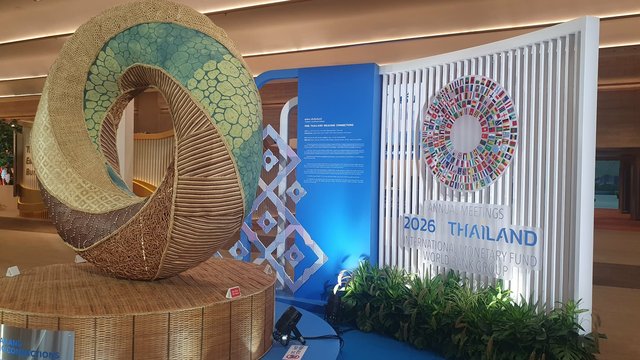
Wars and conflicts continue to cause severe humanitarian suffering, accompanied by significant economic costs and tangible negative side effects, which hit the poorest and most vulnerable segments of the population the hardest, according to a statement from the 54th meeting of the International Monetary and Financial Committee (IMFC) in Bangkok on Saturday.
"Ending wars and conflicts and securing lasting peace around the world remains essential for sustainable growth and long-term stability," the statement's introduction notes, without specifying particular conflicts, according to an Interfax-Ukraine correspondent.
The IMFC, which is the key advisory body of the International Monetary Fund (IMF), noted that the global economy weathered the latest shock better than expected, but such resilience should not be taken for granted.
"Disruptions to supply chains are adding to uncertainty and price pressures. Major structural transformations are underway. In this more complex environment, which brings opportunities but also risks, our priority remains to promote macroeconomic and financial stability while enabling broad-based, private sector-led growth, and strengthening resilience through credible policies and international cooperation," the document states.
The committee pins its hopes for growth on the rapid development of cutting-edge intellectual technologies, which stimulate investment and trade and can help boost productivity, but notes that low-income countries and fragile states risk falling even further behind in development.
"Risks remain tilted to the downside: escalating conflicts and trade tensions could further disrupt critical trade routes, exacerbate commodity price pressures, including in refined energy products, and worsen energy and food insecurity," the statement reads.
The IMFC also draws attention to rising yields on sovereign bonds in major economies, which are negatively affecting global financial conditions against the backdrop of high public debt and refinancing needs in many countries.
"Rapid technological change, demographic shifts, more frequent extreme weather events and natural disasters, and geoeconomic fragmentation are compounding policy tradeoffs," the committee adds, painting a bleak picture.
It calls for sound and consistent macroeconomic policies and multilateral cooperation, as well as fiscal consolidation efforts to ensure debt sustainability, while protecting the most vulnerable and prioritizing investments that stimulate productivity and growth.
The statement also emphasizes the importance of preserving central bank independence to maintain confidence in policy and keep inflation expectations stable, and advises banks to remain firmly committed to ensuring price stability in accordance with their mandates.
"We underscore the importance of secure and resilient energy flows and of upholding the principle of freedom of navigation as essential to global economic stability," the IMFC also stated.
Regarding artificial intelligence – whose positive impacts and risks to global and national economies were one of the main topics at the annual meeting in Bangkok – the committee looks forward to further analysis of the situation by the IMF and its recommendations.
The next IMFC meeting will take place in April 2027 in Washington.