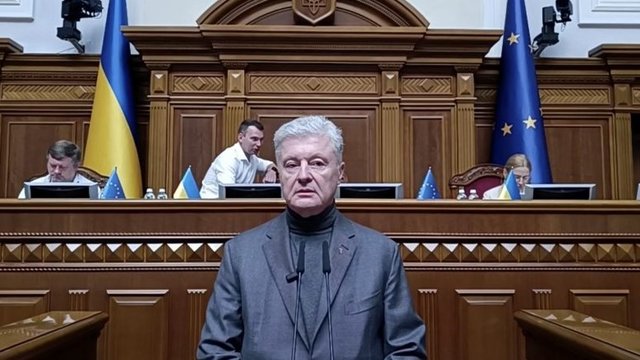
The European Solidarity party faction in the current 9th convocation of the Verkhovna Rada holds the highest public performance ratings among Ukrainians, although negative evaluations outweigh positive ones across all parliamentary political forces, according to the results of a nationwide public opinion poll conducted by the Kyiv International Institute of Sociology (KMIS) between September 12 and 21. Commissioned by Forum NGO, the survey included questions assessing the performance of parliamentary factions and identifying perceived opposition leaders.
Some 38% of respondents believe the European Solidarity faction's activities benefit Ukraine, compared to 43% who believe they hinder development. In September 2025, 38% considered the faction's activities beneficial and 36% viewed them as a hindrance.
The Holos party faction follows in the rankings: 30% of respondents consider its activities beneficial to Ukraine, while 31% hold the opposite view. Ratings have slightly worsened compared to September 2025, when 33% noted benefits and 27% cited hindrances.
Meanwhile, 22% of respondents consider the Servant of the People faction's activities beneficial, while 66% believe its actions hinder state development (compared to 52% last year).
Similar negative trends are evident for the Batkivshchyna All-Ukrainian Union faction, whose activities are deemed beneficial by 21%, while 68% view them as hindering state development (up from 48% in September 2025).
Regarding Platform for Life and Peace group, 16% believe its activities benefit Ukraine, while 43% disagree. This represents no significant change compared to September 2025.
Overall, a majority of respondents (64%) positively evaluate the performance of at least one faction from the list, up from 59% in September 2025.
Respondents were also asked to identify the leader of the opposition in Ukraine; a majority (68%) were able to select a public figure from a list of six politicians. The largest relative share pointed to European Solidarity leader and MP Petro Poroshenko (30%). He is followed by MP Dmytro Razumkov (11%), volunteer and public figure Serhiy Prytula (8%), and Batkivshchyna leader and MP Yulia Tymoshenko (6%). MPs Yuriy Boiko and former Presidential Office advisor Oleksiy Arestovych were each named by 3% of respondents.
An additional 11% believe there is no genuine opposition in Ukraine (down from 16% in February). Compared to February, the shares of respondents naming Poroshenko (previously 24%) and Razumkov (previously 7%) increased, while metrics for other figures remained unchanged.
Commenting on the survey results, KMIS Executive Director Anton Hrushetsky noted that the crisis of trust in parliament among Ukrainians persists. "In effect, Ukrainians believe the parliament is more of a hindrance than a contributor to the country's development. Naturally, the critical attitude of Ukrainians toward the Verkhovna Rada and parliamentary political forces is not new... But during wartime, this situation is particularly alarming. It is especially critical that in the case of the Servant of the People faction—which forms the basis of the coalition and the current government—those who believe its actions hinder development outnumber those who see it as contributing by a factor of three," he stated.
Hrushetsky emphasized that the Verkhovna Rada is expected to pass necessary legislation to secure funding from Western partners and demonstrate Ukraine's fulfillment of European integration obligations, noting that opposition MPs must also demonstrate their responsibility.
The survey was conducted via telephone interviews (CATI) using a random sample of mobile phone numbers across all government-controlled regions among 1,002 respondents aged 18 and older. Under normal conditions, the formal statistical margin of error for such a sample (with a 0.95 probability and design effect of 1.3) does not exceed 4.1% for indicators near 50% and 1.8% for indicators near 5%, though wartime conditions introduce additional systematic deviation.