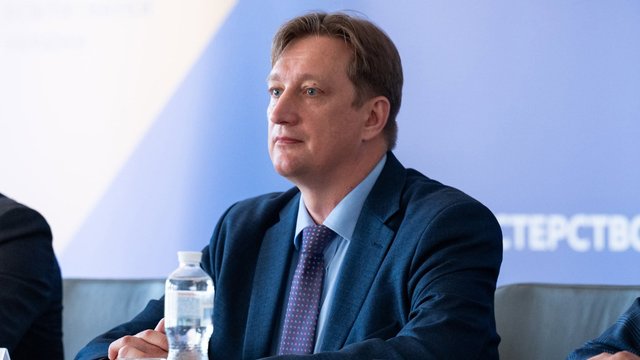
Minister of Education and Science Andriy Butenko has explained what recommendations on adjusting lesson durations in connection with prolonged air raid alerts mean.
"Since yesterday, a fragment from a broadcast on one of the television channels regarding the possibility of shortening classes has been circulating on social media. But it is important to understand the context of the conversation with journalists in which these words were spoken. We are not proposing to shorten the duration of all classes to 35 minutes. We are talking about how to organize learning when children spend hours in shelters, do not sleep due to nighttime shelling, and come to school exhausted," Butenko wrote on Facebook.
He noted that today Ukrainian schools operate in very different security conditions due to air raid alerts, and the education system cannot ignore the physical and psycho-emotional state of children.
"At the same time, we must do everything to ensure that children continue to receive a quality education. That is why, at the request of teachers, we, together with educators, parent organizations, school principals, and heads of education departments, have developed methodological recommendations that give schools the opportunity to more flexibly organize learning during prolonged and repeated air raid alerts," he added.
According to him, flexible lesson duration means that if children study in a shelter for a long time, the teacher can adapt the class, in particular shorten its duration, taking into account the age and psycho-emotional state of the students, while it is important to adapt the educational material accordingly so that students achieve the results provided by the educational program.
"Schedule adjustment. If students missed classes due to a prolonged air raid alert, in elementary school you can change their sequence so that after the all-clear signal, the necessary time can be devoted to subjects that require greater concentration and direct work with the teacher. In basic and senior school, this is also possible, but requires advance processing by the management of the institution of various scenarios for schedule adjustment," the minister wrote.
Butenko emphasized that these recommendations are not an order, but merely a tool for educators.
"Separately, I want to remind you that the Sanitary Regulations define the maximum duration of a continuous class: 35 minutes for the first grade, 40 minutes for grades 2-4, and 45 minutes for grades 5-11(12). This does not mean that every lesson under any circumstances must necessarily last exactly that long. We recommend that school principals provide for various scenarios of organizing education in advance in case of prolonged alerts and remain in constant contact with the regions to help in this process," the head of the department stated.
He also recalled that the law on general secondary education provides for the possibility for an institution to flexibly organize the educational process, in particular to adjust the duration of classes.
"I trust our teachers and school principals. It is they who see the condition of children every day, know the capabilities of their institutions, and understand how to organize learning under specific circumstances. The ministry's task is to provide them with clear recommendations, provide the necessary flexibility, and, of course, help in this process. We cannot predict how long the next air raid alert will last. But we can prepare in advance for various scenarios to preserve the most important thing in each of them: the safety of children, their health, and the opportunity to continue learning," the minister wrote.