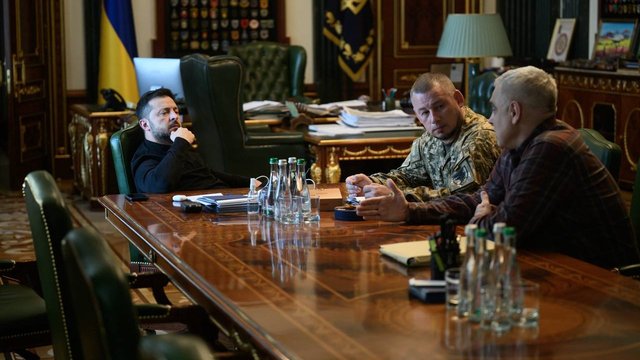
Ukraine is prepared to sign a landmark drone defense agreement with the United States, according to CBS News reports. Sources familiar with the situation indicated that President of Ukraine Volodymyr Zelenskyy was ready to sign the deal on the sidelines of the United Nations General Assembly taking place this week in New York City.
At the same time, the sources noted that the agreement might instead be finalized at a later date when the U.S. was ready to do so.
The report stated that sources familiar with the details of the drone deal noted that it would go beyond awarding contracts to a handful of Ukrainian companies, aiming instead to create a broader framework for leading Ukrainian defense firms to work directly with American counterparts and the U.S. military.
In recent months, Washington's efforts to absorb lessons learned from drone warfare in Ukraine have been uneven. In August, the U.S. Army phased out a drone battalion tasked with studying those lessons. Two of the unit's most prominent backers—former Army Chief of Staff Gen. Randy George and former commander of U.S. Armed Forces in Europe and Africa Gen. Christopher Donahue—were dismissed or forced to retire earlier this year.
However, the Pentagon has also taken steps to expand its own drone arsenal. Under the U.S. "Drone Dominance Program," American and select foreign companies—primarily Ukrainian ones—were invited to compete for contracts to supply drones to the U.S. armed forces, with the program aiming to procure more than 200,000 drones by 2027.
Skyfall, one of Ukraine's largest drone manufacturers, won the first stage of selection under the program earlier this year, while Perennial Autonomy and Neros, another American manufacturer with a presence in Ukraine, won the second round.
Deborah Fairlamb, founding partner of Green Flag Ventures, an American venture capital firm investing in Ukrainian defense technology, noted that the most critical lesson for the U.S. and its allies was that Ukraine's advantage lay not only in the drones themselves, but in the software, operators, and teams that constantly adapted them.
She stated that there was a sort of misconception that one could just buy the technology and it would somehow work on its own, adding that in reality, the West needed to better realize that it was not just about having the technology, but how it was used, which was why Ukraine's knowledge, skills, and experience needed to be transmitted along with it rather than treating it simply like a rifle that could be pointed and shot.
Fairlamb further noted that the value of the agreement would hinge on the ability to transfer Ukraine's operational experience alongside the technologies.
The expert summarized that a significant part of what related to the use of drones on the battlefield—whether for offensive or defensive purposes—actually required a huge amount of coordination, operational planning, situational awareness, and interaction between drone operators, pointing out that there was a whole chain of events happening parallel to the use of drones that people tended to overlook, but which formed an absolute integral part of Ukrainians' understanding of how they utilized drones.