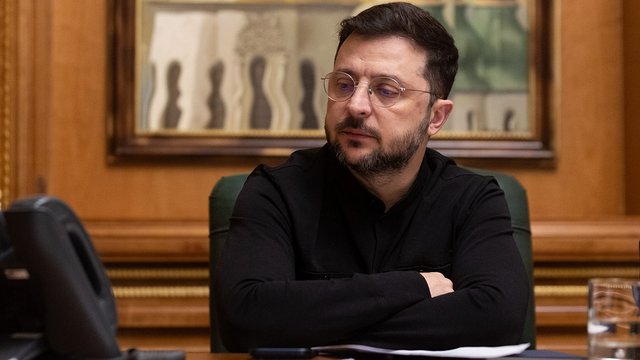
Some 54% of Ukrainians trust Ukrainian President Volodymyr Zelenskyy, while 41% do not; with a trust-distrust balance of 13% more, according to the results of a poll conducted by Kyiv International Institute of Sociology (KIIS) from August 21 to September 10.
Among the 54% who trust Zelenskyy, 18% "fully" trust him, while the remaining 36% "somewhat" trust him. Among those who do not trust him, 25% "do not trust him at all," and 16% "tend not to trust him."
Zelenskyy enjoys the highest levels of trust (a balance 1.5 times or more, higher than the national average, i.e., 20% more and above): by gender – among women (balance 23% more); by age – 18- to 29-year-olds (23% more); by region – residents of the central and northern (21% more), southern (24% more), and eastern (21% more) parts of the country. By type of settlement, he is trusted more by residents of villages (20% more), towns with a population of up to 20,000 / urban-type settlements (26% more), and towns with a population of 20,000-99,000 (23% more); by education level – people with a high school diploma or less (21% more); by occupation – military personnel and police officers (32% more), students (34% more), and the unemployed (39% more).
Those who trust Zelenskyy the least (with a balance 1.5 times or more below the national average, i.e., 9% more or lower) are: by gender – men (balance 0%, i.e., an equal number trust him and do not trust him); by age – those aged 45-59 (4% more); by region – residents of the west (3% more) and Kyiv (6% less). By type of settlement, residents of cities with a population of 100,000 or more trust him the least (4% more); by education – people with a college degree (7% more); by occupation – blue-collar workers (5% more), entrepreneurs/self-employed/farmers (12% less), and homemakers (3% more); by primary language spoken at home – Russian-speaking citizens (4% less); by household income level – those with low (8% more) and very low (9% less) incomes.
In late July and early August of this year, 55% of respondents trusted Zelenskyy, while 40% did not. In other words, the level of trust has remained virtually unchanged over the past month.
It is noted that the fieldwork phase of the survey began immediately after the NABU and SAPO investigation "Forrest Gump," which resulted in the dismissal of Iryna Mudra, deputy head of the President's Office. Additionally, about half of the interviews were conducted starting on September 4, that is, after a new investigation titled "Carthage" into the Prosecutor General's Office, but did not cover subsequent events starting September 14, when the former Prosecutor General attempted to launch an offensive against NABU and the SAPO.
The survey was conducted via telephone interviews (CATI) in all government-controlled regions of Ukraine among 1,003 adult respondents. Formally, under normal circumstances, the statistical margin of error for such a sample (with a 0.95 confidence level and taking into account aeffect of 1.3) would not exceed 4.1% for indicators close to 50% and 1.8% for indicators close to 5%; however, under wartime conditions, a certain systematic deviation is added to this margin of error.