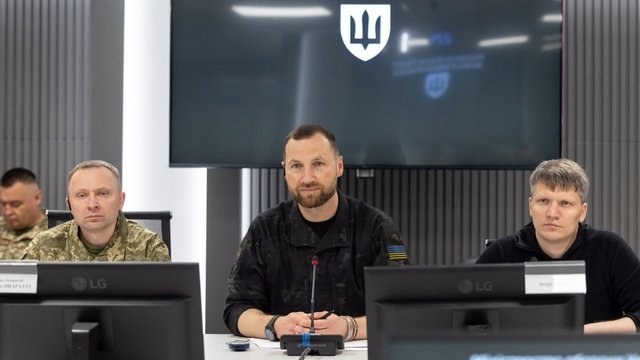
Ukraine is counting on increased support from partners to reduce Russia's ability to wage war, the Defense Ministry said following a meeting with the national security advisers of France, Germany and the United Kingdom.
Defense Minister Yevhen Khmara and Commander-in-Chief Mykhailo Drapaty met with French, German and British national security advisers Emmanuel Bonne, Guenter Sautter and Jonathan Powell, the Defense Ministry said on Telegram Monday.
They briefed the partners on the battlefield situation, the Defense Forces' strategy and actions, particularly in eastern Ukraine. Khmara stressed that Ukraine is preparing for the possibility that Russia will announce a new wave of mobilization. The sides discussed potential challenges and the means needed to reduce Russia's ability to wage war.
"Deep strike is an important area — it's one of the tools for depriving Russia of the ability to finance its aggression against Ukraine. At the same time, comprehensive work with partners to strengthen sanctions pressure on Russia remains necessary," the ministry said.
The sides also discussed Ukraine's priorities for air defense, with a focus on accelerating the FREYJA anti-ballistic project, and Ukraine gave partners a specific list of needs required to complete it.
"They also discussed the potential for cooperation in the cognitive domain. Yevhen Khmara stressed that Ukraine is ready to develop mutually beneficial projects that will strengthen both sides," the Defense Ministry said.
The cognitive domain is the operational space or dimension in which human thinking, perception of reality, beliefs, emotions and social attitudes are shaped. The term is used in military affairs, geopolitics and strategic communications. Unlike traditional physical domains (land, sea, air) or technological ones (space, cyberspace), the cognitive domain encompasses the human mind and the information environment that shapes it.