The foundations of Ukraine's energy markets, reformed in 2019-2021, require further development of market mechanisms alongside the gradual phaseout of public service obligations (PSOs) imposed on state-owned companies, according to an October technical report by the International Monetary Fund (IMF), "Assessment of Energy Subsidy Fiscal Cost and Reform Options."
"Strengthening competition, improving liquidity, enhancing physical balancing efficiency to avoid supply disruptions, and using nuclear generation as a stabilizing asset in the electricity market will be key to building a resilient, competitive and regionally integrated energy system over the medium and long term," the report says.
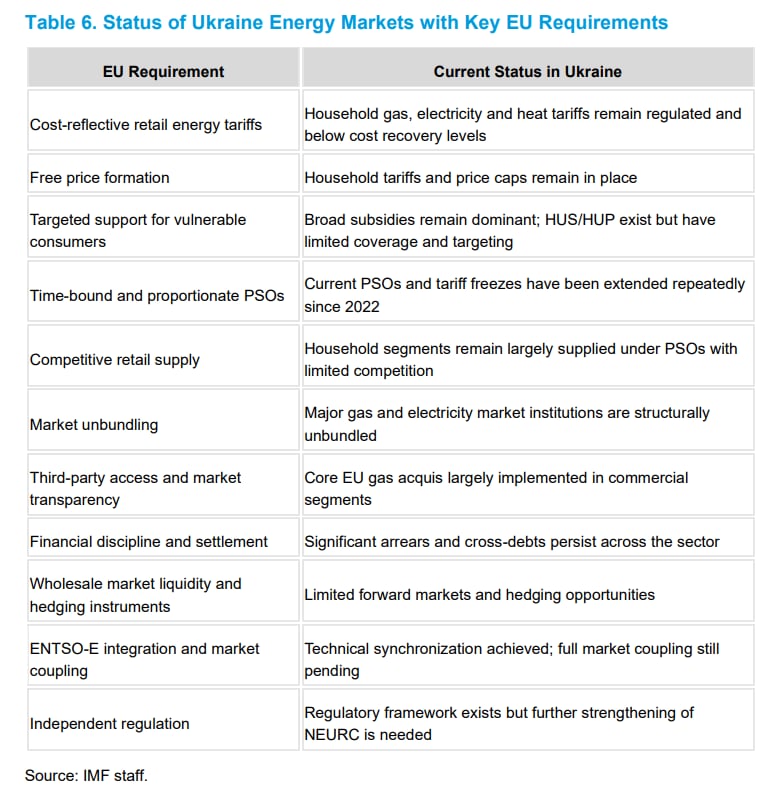
The IMF experts say Ukraine's natural gas market would benefit from greater competition and modernization of its distribution network.
"Although the market formally complies with EU principles, Naftogaz's dominant role in production, wholesale and retail segments creates barriers to entry for private market participants, thereby limiting competition, reducing liquidity and weakening efficient price formation," the report says.
The authors note that the legal unbundling of Naftogaz was introduced at the transmission level, but operational links and coordination roles across production, storage, supply and distribution reduce transparency and create implicit advantages over other market participants.
In the medium term, lifting the ban on gas exports could encourage new companies to enter the market and strengthen competition, the experts say.
Regarding Naftogaz's recent consolidation of regional gas distribution system operators under the management of Gazmerezhi, the report acknowledges that the move has operational advantages in wartime. However, a postwar modernization roadmap for the operators should focus on unbundling to improve operational transparency, encourage reductions in technical losses, upgrade metering systems and ensure cost-reflective tariffs to support efficient infrastructure use.
The electricity market requires deeper reforms to move towards a fully competitive system, the IMF experts say. Priorities should include reducing market price volatility, restoring financial stability in the balancing market and modernizing distribution networks.
To reduce price volatility, the report proposes developing a liquid long-term market to support hedging and investment. Limited access to forward contracts and hedging instruments currently exposes market participants to high price volatility and constrains investment decisions, particularly in new generation capacity, the authors argue.
Structured access to nuclear generation, which accounts for a dominant share of Ukraine's overall electricity generation, could also serve as an effective hedging instrument, they say. A mechanism modeled on European experience, such as France's regulated access to historic nuclear electricity system (ARENH), could allow part of nuclear output to be allocated at cost-reflective prices, stabilizing supply costs for suppliers and large consumers while preserving market signals.
The IMF experts also emphasize that clearing legacy debts and strengthening governance should be an initial step. These measures may require financial restructuring combined with stricter rules to prevent the accumulation of new arrears, but would help establish long-term confidence in the system.
"Enhancing flexibility and developing ancillary services markets are key next steps. This will require the development of competitive reserve markets that allow participation by distributed generation and demand response," the report says.
As for electricity distribution networks, the authors note that the transition to distributed generation requires more flexible, digitalized grids supported by smart-grid technologies and advanced metering systems capable of managing decentralized and variable energy flows.
"A strong regulatory framework overseen by an equally strong and independent regulator is a cross-sector priority for both the gas and electricity markets. Reforms of the National Energy and Utilities Regulatory Commission (NEURC) have faced significant delays and must be resumed to ensure successful market reforms," the IMF experts say.
The updated Extended Fund Facility (EFF) program includes a related structural benchmark requiring legislation to strengthen NEURC's independence by the end of October 2026. The deadline has already passed, however, as the relevant bill has so far been adopted only at first reading.
The report was prepared following a technical assistance mission by the IMF's Fiscal Affairs Department (FAD), whose experts visited Kyiv at the Ukrainian government's invitation on June 14-19, 2026. The mission examined subsidies for natural gas, electricity and district heating. The delegation met with representatives of the Social Policy Ministry, Energy Ministry, Communities and Territories Development Ministry and Finance Ministry, as well as Naftogaz, Energoatom, Ukrinterenergo, DTEK Group, the Guaranteed Buyer and the State Statistics Service.
The IMF experts estimated that fiscal costs of energy subsidies associated with PSOs and similar measures averaged 3.7% of GDP annually in 2024-2026. Electricity subsidies accounted for about 1.8% of GDP and gas subsidies for about 1.4%.
A further 0.3% of GDP represented subsidies for household heating outside any PSO system, resulting from the moratorium on increases in utility prices, while subsidies to renewable electricity producers accounted for another 0.2% of GDP.
The subsidy shortfall is financed almost entirely by the two main state-owned energy companies, Energoatom and Naftogaz Ukrainy, while regional district heating companies bear the costs of heating subsidies. This obscures fiscal obligations and expenditure, weakens accountability and undermines the sustainability of the sector, the report says.