Fiscal costs of energy subsidies associated with Ukraine's public service obligation (PSO) mechanism and similar measures reached 3.7% of GDP annually in 2024-2026, as household electricity and gas tariffs covered less than half of market prices, according to an International Monetary Fund technical assistance report.
The October report, "Assessment of Energy Subsidy Fiscal Cost and Reform Options," says household electricity and gas tariffs currently cover 41% and 49% of cost-recovery levels, respectively. Electricity PSO subsidies account for about 1.8% of GDP, while gas PSO subsidies account for about 1.4%.
A further 0.3% of GDP represents subsidies for household heating outside the PSO system, resulting from the moratorium on increases in utility prices. Subsidies to renewable electricity producers account for another 0.2% of GDP.
The IMF says the current PSO arrangements operate as quasi-fiscal measures, with Naftogaz and Energoatom covering most subsidy costs through their balance sheets. This obscures fiscal obligations and expenditure, weakens accountability and undermines the sustainability of the energy sector.
The report proposes two scenarios for phasing out the PSO over three years, both involving gradual tariff increases accompanied by targeted social assistance for the most vulnerable households.
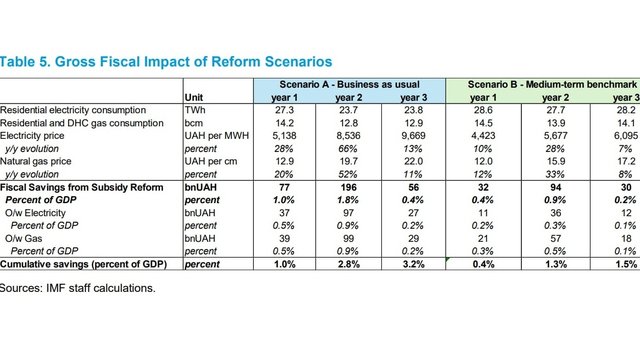
Under Scenario A, described as a continuation of current conditions, the target electricity tariff in the third year would reach UAH 9.7 per kWh, while the gas tariff would rise to UAH 22 per cubic meter, including VAT. This would represent overall increases of 141% for electricity and 104% for gas.
Under Scenario B, based on a postwar medium-term steady-state scenario that includes improved supply efficiency and transparently assessed reconstruction needs, the target electricity tariff would be UAH 6 per kWh and the gas tariff UAH 17.2 per cubic meter, including VAT. The respective overall increases would be 52% and 60%.
In both scenarios, the PSO would be phased out in stages: 20% in the first year, 60% in the second and the remaining 20% in the third.
The IMF estimates that the full reform package would generate fiscal savings of 3.2% of GDP under Scenario A and 1.5% under Scenario B.
The projected gains include the immediate restoration of cost recovery for household district heating, the tariff difference for which is currently financed through district heating companies' debt to Naftogaz. That debt reached 1% of GDP in January, the report says, as well as the gradual reduction of electricity and gas tariff gaps.
The fund says changes to energy tariffs should be accompanied by adequate social support outside the pricing system. It does not recommend introducing targeted social energy tariffs at this stage, noting that such arrangements are strictly regulated under the European Union's Third and Fourth Energy Packages and require a high level of monitoring, particularly at the distribution stage, which Ukraine currently lacks.
The report also notes that below-cost tariffs result in additional lost tax revenue. Uncollected VAT on the gas market averaged 0.2% of GDP in 2024-2026. Lost VAT and excise revenue on the electricity market amounted to 0.2% of GDP in 2024 and 2025 and 0.1% in 2026.
The report was prepared following a technical assistance mission by the IMF's Fiscal Affairs Department, whose experts visited Kyiv at the Ukrainian government's invitation on June 14-19, 2026. The mission examined subsidies for natural gas, electricity and district heating and met with representatives of relevant Ukrainian ministries, Naftogaz, Energoatom, Ukrinterenergo, DTEK, the Guaranteed Buyer and the State Statistics Service.