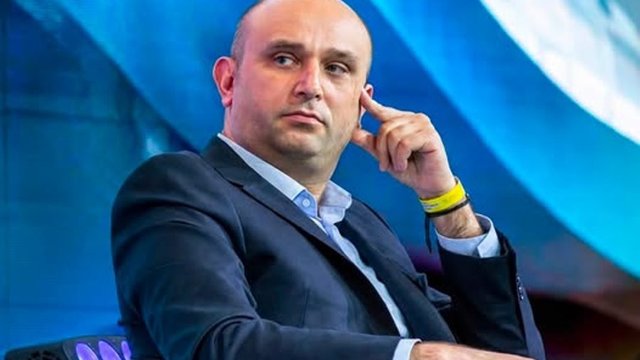
The International Monetary Fund (IMF) estimates Ukraine's uncovered external financing needs for budget expenditures in 2027–2028 at $50 billion–$55 billion: $30 billion–$35 billion next year and another $20 billion in 2028. Instruments linked to frozen Russian assets are being considered among the key sources for covering these needs, Vladyslav Rashkovan, Ukraine's Alternate Executive Director at the IMF, said.
"I am confident that Russian assets will remain our key issue both now and in the future. It seems to me that over the next two months, the range of options available to us for financing 2027 will lie somewhere between ERA-2 and Ukraine Support Loan-2," he said in an interview with Interfax-Ukraine on the sidelines of the annual meetings of the International Monetary Fund and the World Bank Group, held in Bangkok on October 12–18.
Rashkovan clarified that IMF assistance with financing would cover nonmilitary budget expenditures, while additional defense financing needs would remain. Finance Minister Serhiy Marchenko estimates Ukraine's defense financing needs for next year at EUR 40 billion. That is why Ukrainian President Volodymyr Zelenskyy announced Ukraine's total need for additional financing next year at EUR 70 billion during a European Council meeting in Brussels on October 14.
The IMF Alternate Executive Director said that Ukraine's international partners are currently more focused on covering financing needs for 2026–2027, although the Fund's Extended Fund Facility (EFF) with Ukraine runs through 2029, and there is an understanding that financing needs in 2028 will also be substantial.
He referred to the Ex-Post Assessment of the previous "wartime" EFF program for 2023–2025, which contained an important conclusion: even if the war ends, for example, in 2027, this does not mean that public finances will return to normal as early as 2028, partly because demobilization cannot happen immediately and social spending will need to increase to support veterans and their families.
"Therefore, even if the war ends in 2028, almost the same amount will be needed. Expenditures will begin to decline only later. This is the model the IMF is working with today... This figure will not come as a surprise to our partners," Rashkovan explained.
As for the main sources of financing other than frozen Russian assets, he pointed to the EU's multiannual budget for 2028–2034, which is being discussed by the European Council.
"European officials assure us that support for Ukraine will be included in it. The current draft allocates EUR 100 billion for Ukraine. We will see what the final structure of the document looks like after the political discussions within the EU. I think it should be agreed by the end of the year," Ukraine's representative at the IMF said, describing the current status of this funding source.
Regarding frozen Russian assets, Rashkovan recalled that most of them are held in Belgium at the international depository Euroclear. They are invested in various instruments of the European Central Bank and the National Bank of Belgium and generate income. In 2024, the G7 established the ERA mechanism, based on discounting future cash flows generated by the continued investment of these assets. Through this mechanism, Ukraine received $50 billion. These are nominally loans serviced using revenues from Russian assets, but for Ukraine they are effectively grants with no repayment obligations or conditions.
After the failure to introduce a EUR 140 billion reparations loan, which European countries lacked the courage to implement at the end of 2025, the EU developed the Ukraine Support Loan mechanism, worth EUR 90 billion for 2026–2027, to provide military and nonmilitary support to Ukraine, Rashkovan added. He clarified that this is also nonrepayable assistance to Ukraine, but it is financed by EU taxpayers.
"I think that over the next two months, discussions within the G7 will revolve around these two instruments (ERA-2 and Ukraine Support Loan-2). Another option would be to look for unused funds in European Union budget programs. I do not have full access to this information, but I am afraid that EUR 70 billion will not be available there," the expert said.
He explained that ERA-2 would again be a financial engineering instrument built around the valuation of future cash flows. While ERA covered a 30-year period, a longer-term model is now being considered, for example, one spanning 50 years. Last December, the European Council decided that the EU would not return Russia's assets until reparations had been paid, significantly reducing the risk associated with this mechanism, Rashkovan said.
According to him, the amount of assistance to Ukraine could also be increased by raising the expected return on investments of Russian assets from the current average of 2.8% annually to, for example, 4% annually, given that yields on U.S. and European government securities are currently around 5%.
"Finally, we know that the assets are not held exclusively at Euroclear. Around EUR 30 billion is held in private French banks. It would be worth provisionally factoring in these funds when developing the model as well," Ukraine's representative at the IMF added.
Summing up, he said that such planning and financial engineering could mobilize around $20 billion for Ukraine, but this would not solve all its problems, particularly given military spending.
"Ultimately, we will still have to turn to G7 finance ministers to cover those costs, because their countries are the ones financing them. (Therefore,) the second option is the Ukraine Support Loan," Rashkovan said.
In his view, it would be possible to increase the size of this instrument beyond the initial EUR 90 billion, the amount determined by the IMF last year.
"If the Fund had identified a need for EUR 140 billion, our partners would have looked for EUR 140 billion. Therefore, it is important now to agree on a common understanding of the total amount: $30–35 billion in nonmilitary needs plus EUR 40 billion in military expenditures, for a total of approximately EUR 70 billion. Accordingly, the ceiling for the Ukraine Support Loan needs to be increased. The instrument and its legal framework already exist; the only thing needed is to raise the lending limit," Ukraine's representative at the IMF said, outlining a possible course of events.
He clarified that in this case, the European Union would have to raise the funds on the market before providing them to Ukraine. At an interest rate of 4%–5%, this would cost approximately EUR 3 billion annually in interest, which European countries would like to cover through assistance from non-European G7 countries. In that case, the mechanism would be almost cost-free for both the European Union and Ukraine.
Among less realistic sources of financing, Rashkovan also mentioned the $5 billion frozen in the United States and the REPO Act (Rebuilding Economic Prosperity and Opportunity for Ukrainians Act), adopted in April 2024. The law allows the U.S. president to confiscate Russian sovereign assets under U.S. jurisdiction and direct them toward assistance to Ukraine.
"Unfortunately, it was not applied even under the Biden administration, and this has still not been done. That is why another initiative, called the PEACE Act, has emerged. It effectively requires the U.S. Treasury secretary, within 90 days after the law enters into force, to seize the relevant assets and transfer the funds to the Ukraine Support Fund. These funds could also be used to purchase defense equipment for Ukraine. The bill has not yet become law, but it is important that discussions on sanctions are continuing," the expert said, describing the current situation.
Another option he mentioned was a levy on Russian oil, similar to the one that existed for Iraq. It could also become a source of funding for the International Claims Commission, established in The Hague.
As for the confiscation of Russian assets, Rashkovan believes it may become possible in the future and that work on the issue should therefore continue.
"Some people propose returning Russia's assets as part of the price of peace. I categorically oppose this: the idea is fundamentally misguided... We know that Russia has no intention of stopping. Therefore, returning the assets would not be the price of peace for Russia, but a prize: it would simply say 'thank you' and carry on," Ukraine's representative said.