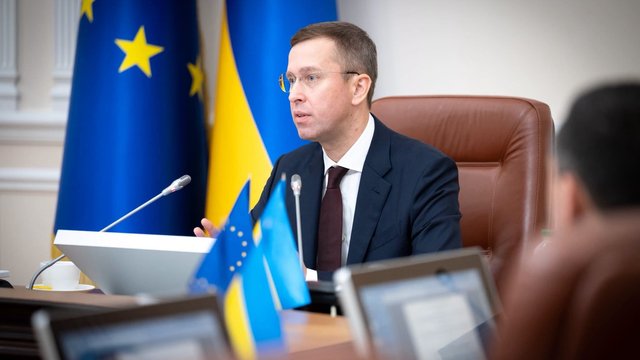
The International Monetary Fund estimates Ukraine's unconfirmed external financing needs for the 2027 state budget at $30-35 billion, and the funds will be found if Ukraine fulfills its side of the commitments, Vladyslav Rashkovan, Ukraine's Alternate Executive Director at the IMF, believes.
"The money will be there if we continue working as we have over the past few months," he said in an interview with Interfax-Ukraine on the sidelines of the Annual Meetings of the International Monetary Fund and World Bank Group, held in Bangkok on October 12-18.
Rashkovan recalled that next year's budget envisages a need for $52.5 billion in non-military financing, of which $20 billion has already been secured or at least covered by assurances under existing support instruments. This leaves $32.6 billion requiring additional confirmation, as Finance Minister Serhiy Marchenko has said.
"The IMF assesses the situation similarly. We were in Kyiv in late August and early September and discussed this with the minister, so we understand the figure. When the IMF mission arrives in November ahead of the December review, we will most likely already see, based on data for August, September and possibly October, the impact of the escalation of the war on macroeconomic indicators. It could be significant," the IMF representative said.
He explained that this was why the IMF was taking a more cautious view of next year's external budget financing needs, putting them at $30-35 billion, although the $32.6 billion figure falls within that range.
As for this year, Rashkovan said the IMF believes the funding needed for budget expenditures has been secured because international partners have provided the necessary assurances. However, a significant portion of the financing is scheduled for the fourth quarter and is conditional on meeting requirements under various programs. Last year, by contrast, funding came without additional conditions under the ERA mechanism, which was based on proceeds from frozen Russian assets.
"This year, to receive the money, we have to meet the conditions. That is why the delay occurred: of the nearly $30 billion that remained to be received by year-end, Ukraine was supposed to receive up to $10 billion earlier," Rashkovan said.
He thanked parliament for important votes last week that unlocked funding and said the arrival of Prime Minister Serhiy Koretsky had significantly accelerated work within the government and cooperation with parliament on financing.
"I am very grateful to the prime minister for understanding that one of the functions of a head of government is effectively to be the country's senior treasurer. Securing $50 billion a year is an important task," the IMF alternate executive director said.
He urged Ukraine to maintain this pace, as a significant portion of fourth-quarter financing still requires decisions by the Verkhovna Rada. Ukraine is heavily regulated, he said, meaning many issues have to go through parliament.
Rashkovan stressed that if Ukraine fulfills its commitments, the IMF will be able to help effectively in securing the necessary financing from international partners.
"Yesterday [October 15], the G7 finance ministers met. IMF Managing Director Kristalina Georgieva said: 'Ukraine voted today and did what it promised. Now it is your turn.' The G7 finance ministers effectively replied: 'We have to do this because we must support Ukraine.' We will find a solution," Rashkovan said, describing how the mechanism works in practice.
According to him, the system under which Ukraine and the IMF jointly mobilize funds from international partners has operated throughout the years of the war.
"But everything still starts with Ukraine. It is genuinely difficult for international partners: they have their own political economy, elections, defense spending and so on. However, they promised the IMF they would provide the funds. The Fund is at the center of this assistance system and effectively confirms to partners that Ukraine has fulfilled its part. No other institution has both the necessary tools and the trust of all partners to assess the situation in the country," Rashkovan said.
As reported, during this year's IMF Annual Meetings, the Ukrainian delegation discussed implementation of a new four-year Extended Fund Facility (EFF) program worth $8.1 billion. The program was approved in late February and forms part of total external financing of $136.5 billion for 2026-2029 under the baseline scenario.
In July, the IMF completed the first review of the program and disbursed a second tranche of about $690 million, bringing total financing received under the new program to $2.2 billion. At the same time, some structural benchmarks under the program were not met on schedule. Following the first review, the updated EFF program added eight structural benchmarks, seven of them fiscal.
The current plan is to combine the second and third program reviews and submit them to the IMF Executive Board before December, together with approval of combined third and fourth tranches totaling about $1.65 billion.
Finance Minister Serhiy Marchenko has said that, before the IMF mission expected in November, Ukraine would like to obtain confirmation of all sources of the $52.6 billion in external financing required for the 2027 state budget. At present, about $32.6 billion of that amount still requires additional confirmation.
According to Marchenko, Kyiv expects the European Union to meet its commitment to cover two-thirds of Ukraine's external financing needs next year as well, which would confirm an additional approximately $17.5 billion. As for the remaining roughly $15 billion, the minister said there were several possible sources, including bilateral financing and guarantees, as well as programs with international financial institutions.