Metinvest Polytechnic, a mining and metallurgical university, has developed a practical tool that helps businesses assess the economic benefit of using biomethane instead of natural gas and reduce payments under the EU's carbon border adjustment mechanism (CBAM).
According to the university, Metinvest Polytechnic's experience in reducing CBAM payments for metal products was presented in Jordan, where the research results were unveiled at the international conference ICSIE 2026, which brought together researchers from 45 countries.
"We presented not just an idea of using biomethane but a ready-made tool for economic calculations. It helps determine when switching to alternative fuel is truly beneficial given CBAM payments. It is especially interesting that this problem is relevant not only for Ukraine. Jordan and other countries that export products to the EU face similar challenges. That is why our research aroused interest and became an occasion for international discussion," said Metinvest Polytechnic postgraduate student Ihor Navolniev, who presented to the international scientific community the results of the research conducted jointly with university scientists Vadym Burko and Volodymyr Kukhar.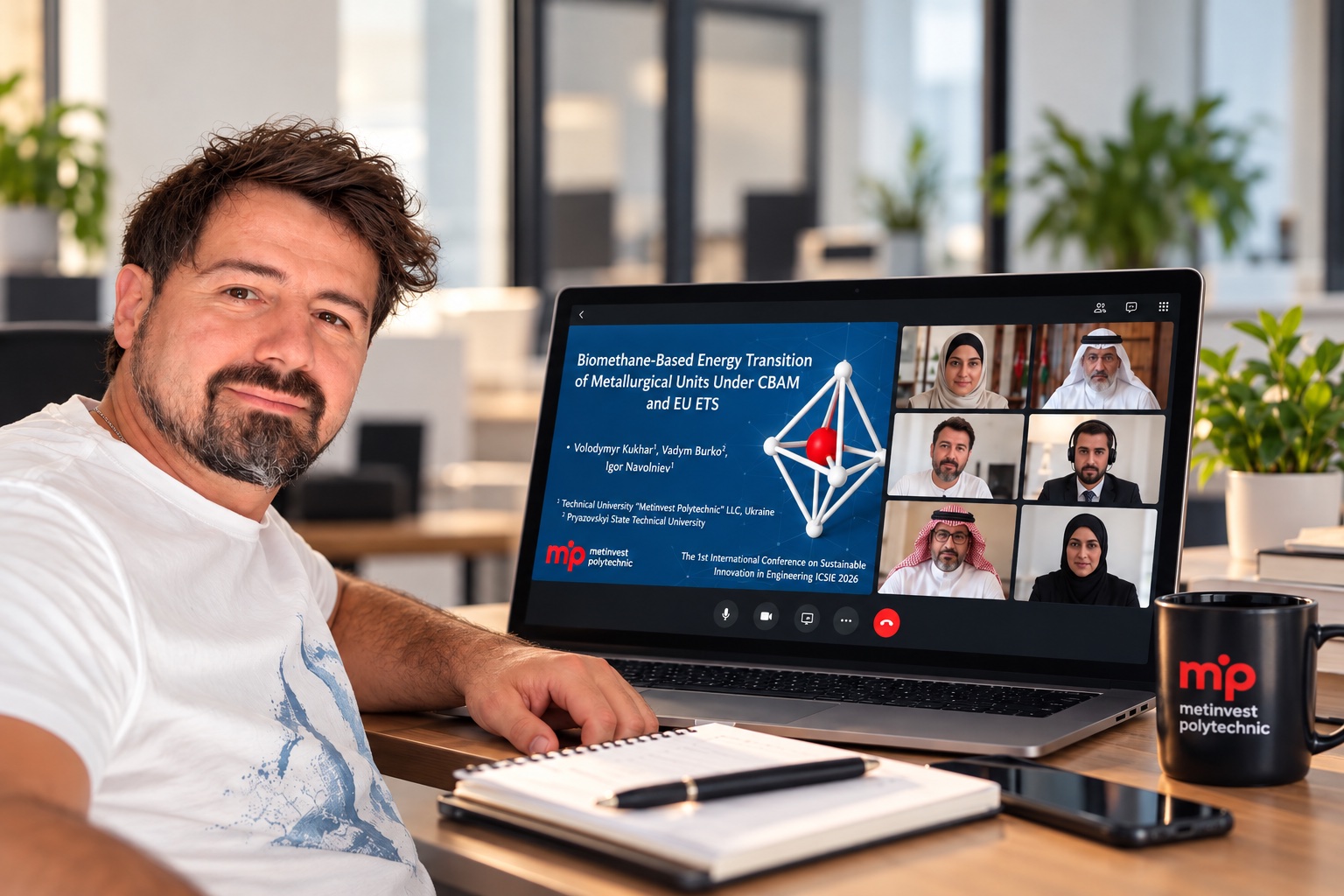
The work was carried out at the request of the technical development and the technology and quality directorates of the Metinvest group. Its main goal is to find economically beneficial ways to reduce the carbon footprint of metal products and cut payments under the European CBAM.
The statement notes that CBAM is changing the rules of international trade: for steel exporters to the EU, not only the price and quality of products but also CO2 emissions during their production are becoming increasingly important.
The team analyzed 16 energy transition scenarios for 2026-2034 and determined the conditions under which using environmentally friendly biomethane instead of natural gas can provide an economic benefit. As part of the research, the scientists developed a ready-made calculation model for businesses that takes into account fuel prices, carbon payments and regulatory factors. This allows enterprises to assess costs in advance, compare alternatives and make informed decisions on decarbonization.
The model demonstrates how a specific enterprise task turns into a tool for managing costs, assessing the effectiveness of decarbonization and reducing the financial risks of CBAM.
The ICSIE 2026 conference was organized by Yarmouk University with the support of IEEE, one of the most authoritative international organizations in engineering and technology. Its program covered 12 scientific areas, from artificial intelligence to renewable energy. The conference proceedings are to be published in the IEEE Xplore digital library and subsequently indexed in the international scientometric database Scopus.
As reported, Ukrainian metallurgy is in a critical situation due to shelling, shutdowns of enterprises, and the EU's introduction of quotas on metal product supplies and the CBAM environmental duty.