The European Union’s support for Ukraine since Russia’s full-scale invasion in February 2022 has reached EUR 228 billion, European Commissioner for Economy and Productivity Valdis Dombrovskis said at the 10th ministerial roundtable on support for Ukraine on Wednesday, on the sidelines of the annual meetings of the International Monetary Fund (IMF) and World Bank in Bangkok.
“The EU is doing its part: EUR 228 billion in support of Ukraine since the start of the full-scale invasion, and that is not all, more to come,” he said on X after the roundtable, which was closed to the press.
Dombrovskis stressed that international partners must join these efforts.
He did not give Interfax-Ukraine other details, but a meeting of the Ukraine Financial Coordination Group with the commissioner is scheduled for Friday, October 16, on the sidelines of the annual meetings.

The Ukrainian side outlined its external financing needs for 2027 and said its sources must be confirmed before the IMF mission in November for the combined second and third reviews of the Extended Fund Facility (EFF) program.
IMF Managing Director Kristalina Georgieva traditionally took part in the roundtable and left after a while, and the fund was then represented by First Deputy Managing Director Daniel Katz, an Interfax-Ukraine correspondent said. Before joining the IMF last year, Katz was U.S. deputy treasury secretary and worked on creating the American-Ukrainian investment fund.
World Bank Vice President Antonella Bassani, European Bank for Reconstruction and Development President Odile Renaud-Basso, International Finance Corporation (IFC) Managing Director Makhtar Diop and IFC Vice President Alfonso Garcia Mora, and European Investment Bank President Nadia Calvino were also present.
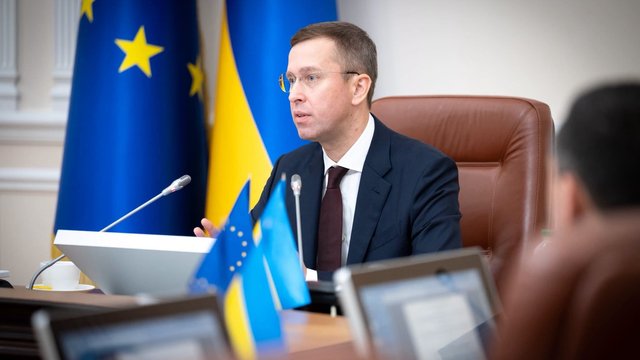
Prime Minister Serhiy Koretsky spoke for Ukraine online, as did Finance Minister Serhiy Marchenko, who stayed in Kyiv because of his report to the Verkhovna Rada on Monday and the adoption of laws important for external financing later in the week. National Bank of Ukraine Governor Andrei Pyshnyy, Economy and Environment Minister Oleksandr Kravchenko and Deputy Finance Minister Olha Zykova also attended.
During the IMF annual meetings, which run on October 12-18, the Ukrainian delegation will discuss with the fund the implementation of the new four-year EFF program of $8.1 billion, approved in late February this year. It is part of total external financing of $136.5 billion in 2026-2029 under the base scenario.
In July, the fund completed the first review of the program and released a second tranche of about $690 million, bringing total financing under the new program to $2.2 billion. Delays in meeting some of the program’s structural benchmarks were recorded. The program, updated after the first review, gained eight structural benchmarks, seven of them fiscal.
The plan now is to combine the second and third reviews and bring them to the executive board by December, together with approval of the combined third and fourth tranches totaling about $1.65 billion.
“Bringing this to the board depends on receiving sufficient and reliable financing assurances to cover the projected funding gap on terms consistent with ensuring Ukraine’s debt sustainability,” IMF spokeswoman Julie Kozack said in early October.
Marchenko said that before the IMF mission’s expected visit in November it would be desirable to get confirmation of all sources of the $52.6 billion of external financing of the state budget in 2027, while about $32.6 billion of that still needs additional confirmation.
He said Kyiv counts on the EU to keep its commitment to cover two-thirds of Ukraine’s external financing needs next year as well, which would add about $17.5 billion to confirmed financing. As for the remaining roughly $15 billion, there are a number of sources for covering it, he said, including bilateral financing and guarantees and programs with international financial institutions.
The first such roundtable took place at the IMF and World Bank spring meetings on April 21, 2022, and the second at the autumn meetings on October 12 that year. They have been held twice a year at these events since.
At the first meeting, the IMF head pointed to Ukraine’s monthly need in 2022 of $5 billion to finance the state budget deficit amid the war Russia unleashed. At the second, President Volodymyr Zelenskyy proposed that the global financial community take three urgent steps in support of Ukraine: create a ‘financial Ramstein,’ ensure economic recovery and help for Ukrainians, and create a mechanism to support investment and insure it against war risks.
At the third, Zelenskyy asked the IMF and World Bank to approve a Support Program to cover priority Rapid Recovery projects worth $14.1 billion, and urged them to work out specific mechanisms for using frozen Russian assets to compensate for the damage Russia caused.