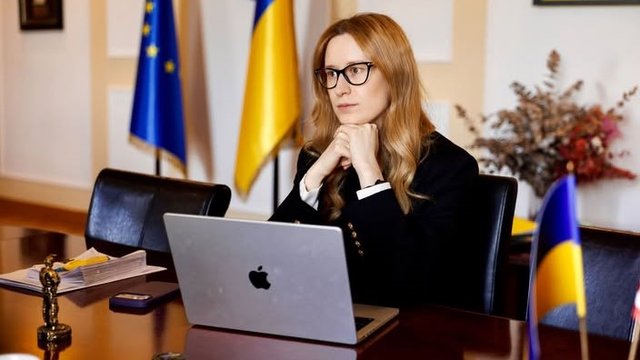
The National Cashback state budget program has become an overly politicized issue in the Verkhovna Rada, and it would therefore be advisable to abandon it when considering the draft state budget of Ukraine for 2027, although this would not result in any significant savings in expenditures, head of the parliamentary Budget Committee Roksolana Pidlasa said.
"I'm simply already fed up with this cashback: any intellectual, professional discussion about the budget comes down to the question, 'Why did you spend money on cashback?' This issue has become so politicized that it overshadows all substantive discussions... I would rather remove this item from the budget altogether for now," she said in an interview with Interfax-Ukraine.
Pidlasa said that the amount of spending on cashback is of no significance in the overall budget picture. According to her, the International Monetary Fund, which has the deepest understanding of the budget and is most interested in the state of Ukraine's public finances, also pays no attention to it when the budget and its structure are discussed.
Regarding the possibility of creating compensation reserve funds in the 2027 state budget by raising the value-added tax rate from 20% to 21% or the fuel excise tax rate by 4 percentage points, the head of the Budget Committee again predicted that the government's proposal would be rejected by the Verkhovna Rada.
In her view, alternative proposals from some business associations to temporarily introduce an import duty are also unlikely to pass through parliament.
"An import duty is the same as VAT, a tax on the end consumer. I think parliament will not do this because it would trigger enormous resistance from society," Pidlasa explained.
"I personally believe that a luxury tax and an increase in speeding fines could be considered. But we understand that all these measures, again, are small and fiscally insignificant. Additional taxes or levies that could have a significant impact on the budget are politically impossible," the committee head added.
She said that under such circumstances, greater focus should be placed on closing schemes through which the budget loses money.
"The effect of some new small tax or even a 1-percentage-point increase in VAT and, for example, stopping the payment of salaries off the books is incomparable: the budget loses many times more money because of off-the-books salaries," Pidlasa said.
A few days ago, Economy and Environment Minister Oleksandr Kravchenko, in an interview with Forbes Ukraine, proposed redesigning the National Cashback state program, which would allow its budget to be cut by 2.5 times and save up to UAH 4 billion.
At present, funding for National Cashback is allocated in tranches from various budget programs as part of the overall Made in Ukraine policy. At the end of June, the Economy Ministry last reported the transfer of another payment tranche for April. At the time, it said that the program had more than 5 million active users receiving monthly payments. More than 2,000 producers participated in the program, having registered more than 422,000 Ukrainian-made products and nearly 1,500 sellers.