
Svitlana Dovhalenko, Economist at CASE Ukraine, PhD
Ukraine’s pay-as-you-go pension system is reaching its limits
Ukraine’s pension system is facing a long-term challenge as demographic constraints increasingly determine its financial sustainability. Will the country have enough contributors to meet its pension obligations to future generations of retirees?
The current system operates on a pay-as-you-go basis: contributions from the economically active population finance benefits for those who have already left the workforce. This makes the pension system heavily dependent on demographic trends. As long as the number of contributors and their incomes grow sufficiently, the system can maintain adequate benefit levels. But when the contribution base shrinks while the number of beneficiaries rises, the resulting deficit ceases to be a temporary budget shortfall and becomes a structural problem.
Ukraine is moving in precisely this direction.
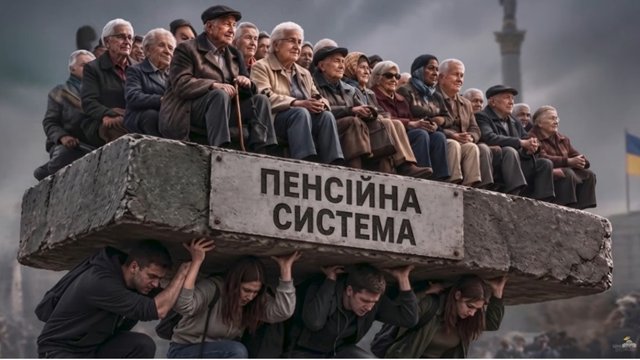
The Pension Arithmetic No Longer Adds Up
Ukraine's population is ageing while fertility rates have fallen far below the level needed to maintain a stable population.
The United Nations ranks Ukraine among the countries with the world's lowest fertility rates, with the figure falling to approximately one child per woman. According to the Global Change Data Lab, Ukraine's total fertility rate stood at just 0.98 children per woman in 2023.
Maintaining a stable population without migration requires a fertility rate of approximately 2.1 children per woman. Ukraine's figure is less than half that level. The generation expected to enter the labour market in large numbers two decades from now will be significantly smaller than today's workforce. This implies a future shortage of contributors to the Unified Social Contribution (USC), which finances pensions.
At the same time, the balance between working life and retirement is changing. According to the United Nations Population Fund, life expectancy at birth in Ukraine in 2025 was approximately 70 years for men and 80 years for women. The standard retirement age starts at 60. Currently, around 67% of the population is aged 15–64, while approximately 19% are older adults. Meanwhile, the share of younger generations continues to decline.
War Has Deepened the Demographic Crisis
Since the start of Russia's full-scale invasion, Ukraine's birth rate has halved. Deaths now outnumber births by nearly 3.6 to one. In the first half of 2026, Ukraine registered more than 73,000 births, compared with approximately 260,000 deaths.
Ukraine is also losing part of its working-age population through migration. According to the United Nations Refugee Agency (UNHCR), 5.68 million refugees from Ukraine were registered worldwide as of 30 June 2026. Eurostat reports that 4.4 million people who fled Ukraine are under temporary protection in EU countries. Adult women account for 43.4% of this group, adult men for 27%, and minors for 29.6%. In other words, more than 70% of Ukrainians abroad are either potential or actual participants in other countries' labour markets.
For the pension system, this means losing part of its future tax and social insurance contribution base. Fewer people work domestically, less income is subject to Ukrainian taxation, and fewer contributions flow into the pay-as-you-go system.
A System Running a Structural Deficit
Before the full-scale invasion, spending on the Pension Fund was the largest expenditure item in Ukraine's consolidated public finances. In 2021, Pension Fund expenditure amounted to UAH 520.9 billion, equivalent to approximately 35% of the country's total expenditure. Of this amount, UAH 177.6 billion was financed directly from the state budget.
Even before the war, contributions from insured workers were insufficient to sustain the system independently. The shortfall had to be covered through general budget revenues.
Today, pension spending is the second-largest expenditure category after national defence. In 2025, approved expenditure by the Pension Fund of Ukraine rose to UAH 1,020.9 billion, nearly doubling over five years.
By comparison, education spending increased from UAH 302.3 billion to UAH 394 billion, a rise of approximately 30%. This illustrates the opportunity cost: every additional hryvnia committed to pension obligations comes at a potential cost to human capital, infrastructure and economic growth.
The pay-as-you-go system is no longer financed solely through contributions from current workers. A substantial share of its cost falls on the state budget. When resources are insufficient, the government seeks additional revenue sources.
For example, Ukraine levies specific charges on passenger car purchases, real estate transactions and mobile telecommunications services. Between January and July 2026, these charges generated UAH 10.6 billion in state budget revenue.
The pension deficit is therefore not merely a problem for the Pension Fund. It is a public finance challenge. And the longer Ukraine maintains a single-pillar pension system, the more heavily the state budget must bear responsibility for its solvency.
Raising Taxes Is Not a Sustainable Solution Either
The government is allocating an increasing share of public resources to pensions, requiring ever-greater revenues. For the pension system, this means one of three things: more contributors, higher declared incomes, or higher tax and social insurance contributions.
The first depends on demographic trends, which are moving in the opposite direction.
The second depends on productivity improvements and economic growth.
The third has inherent limits.
Increasing the tax burden on labour makes formal employment more expensive. The OECD notes that high social security contribution rates, combined with weak enforcement of labour income reporting, create incentives to underreport official wages.
CASE Ukraine estimated the shadow economy at up to 40% of GDP in 2021 and identified undeclared wages, commonly known as envelope salaries, as one of the main channels of economic informality. The resulting budget losses are estimated at up to UAH 262 billion.
Attempting to close the pension deficit indefinitely by increasing the tax burden on labour would therefore be counterproductive. Beyond a certain point, higher contributions could shrink the very formal employment and wage base from which pension revenues are collected.
Political Cycles Are Shorter Than Pension Obligations
The pay-as-you-go system has another structural weakness: its particular vulnerability to political cycles.
Pensioners constitute a large and politically active group of voters. This makes promises of higher pensions especially attractive to politicians.
In 2012, Nataliia Korolevska promised an average monthly wage of €1,000 and a pension of €500. Yuliia Tymoshenko pledged to bring pensions up to the level of average wages.
The problem is not simply whether such promises are realistic, but the long-term fiscal commitments they create.
Politicians can reap immediate electoral benefits by appealing to pensioners, while the financial consequences emerge much later, leaving public finances burdened with obligations for years to come.
The failure to reform the pension system, combined with political populism, has contributed to a situation in which Ukrainian pensioners are becoming poorer even as Pension Fund expenditure continues to rise.
Ukrainians May Reach Retirement Age Without Qualifying for a Pension
Social pressure is likely to intensify as limited fiscal resources become sufficient only to finance meagre benefits, while older people remain among the most politically active voters.
The outlook is troubling. An actuarial assessment of Ukraine's Pension Fund, analysed by the International Labour Organization, suggests that by 2040, only around 40% of people aged 65 and over may qualify for a state old-age pension.
An increasing number of Ukrainians will lack the required contribution records because of low participation in formal employment.
The longer Ukraine postpones reform, the more expensive and disruptive the transition will become.
Efforts to move beyond an exclusively pay-as-you-go model towards a system in which part of retirement income is generated through individual savings began in the early 2000s. Yet, in 35 years of independence, Ukraine has never fully implemented a mandatory funded pension pillar.
Draft Law No. 2683 on mandatory funded pension provision, registered in 2019, has still not resulted in an operational second pillar. Draft Law No. 9212 was returned for revision in April 2024. As of 2026, Draft Law No. 2683 has once again been placed on the parliamentary agenda.
For years, policymakers have debated pension savings while the pay-as-you-go system has remained the principal source of future retirement income.
What Needs to Change?
Ukraine does not need a radical overhaul that abolishes the pay-as-you-go system overnight. It needs a carefully managed transition towards a multi-pillar pension model.
First, a portion of existing social insurance contributions should gradually be redirected into individual retirement savings accounts for younger workers, without introducing an additional payroll tax.
For older age groups, the transition should be more gradual, with government support or co-financing to ensure that people approaching retirement do not bear the costs of reform on their own.
Under this model, the pay-as-you-go pillar would remain the foundation of social insurance, while the funded pillar would begin building personal retirement assets.
Second, pension savings must be invested rather than left idle.
A portion of these funds could be invested in government bonds, but the system must ensure diversification, independent supervision, transparent fees and protection of assets from political interference.
Individuals should be able to track their contributions and investment returns and have the right to pass their accumulated savings on to their heirs.
Third, the parameters of the pay-as-you-go system need to be reviewed.
In 2026, Ukrainians must have 33 years of qualifying insurance contributions to retire at 60, 23 years to retire at 63, or 15 years to retire at 65.
Looking ahead, Ukraine should consider gradually moving towards a retirement age of 65 and a qualifying contribution period of 39–40 years, while providing a lengthy transition period for those approaching retirement.
Fourth, tax policy should focus on reducing the cost of formal employment rather than continually increasing it.
Proposals to lower the effective tax burden on wages, previously discussed by figures including Danylo Hetmantsev and CASE Ukraine experts, make sense only if accompanied by expenditure discipline.
Lower labour taxation should not translate into a larger fiscal deficit. Instead, it should encourage a broader formal tax base, higher employment and greater capacity for individual retirement savings.
Finally, voluntary pension savings should benefit from tax incentives. Individuals need a financial incentive to set aside part of their income for retirement rather than assuming that the state will provide for them in 30 years.
The Cost of Inaction
Ukraine is entering a demographic reality in which the pool of potential pension contributors is shrinking, migration is draining part of the workforce, and the cost of existing pension commitments continues to rise.
The state budget is already covering the gap between contributions and pension expenditure. Establishing a funded pension pillar can therefore no longer remain merely another topic of parliamentary debate.
A funded pension system will not eliminate demographic risks or automatically guarantee generous pensions. Its purpose is different: to ensure that part of an individual's retirement income comes not from contributions paid by the next generation, but from personal savings accumulated throughout working life and the returns earned on their investment.
Without a second source of retirement income, Ukraine will become increasingly dependent on the government's ability to plug pension funding gaps through the state budget, contributions from younger workers and resources that would otherwise be available to future generations.