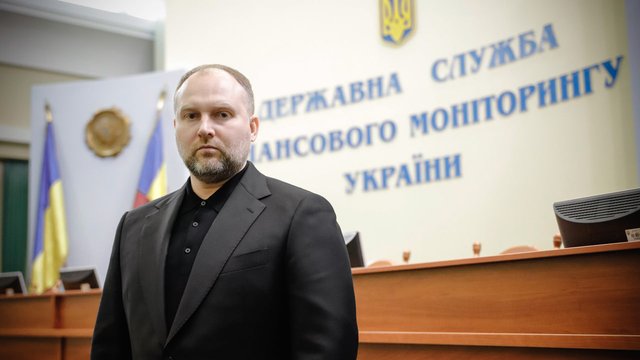
Filip Pronin, Head of the State Financial Monitoring Service of Ukraine
In the fight against fraudulent call centres there is one problem: they can be shut down by the dozen, their operators detained, their phones and servers seized — but as long as the financial infrastructure keeps working, they grow like the heads of the Hydra: for every one neutralised, two new ones immediately spring up.
That is why, in my view, the most interesting aspect of the President's legislative initiatives on combating call centres is that they strike not only at the fraudsters themselves, but also at the networks of so-called "drops" — individuals whose bank accounts and cards are used by third parties.
It is precisely these networks that may prove to be the Achilles' heel of this system.
The logic of any fraud is very simple. It is not enough for a criminal to persuade a person to hand over money. That money has to be received somewhere. Then it must be quickly transferred to other accounts, the financial flow broken up, cashed out, converted or moved into other assets. And all of this must be done in such a way as to make the path leading from the money to the organiser of the scheme as difficult as possible to trace.
This requires "drops" — people who hand over their accounts, cards or access to them to third parties.
And this is exactly where a vulnerability arises in the criminal model.
A call centre can be relocated. Phone numbers can be changed. New operators can be recruited. But without accounts through which the victims' money can be received and withdrawn, the entire machine loses its economic rationale.
The scale of this infrastructure is evident in the figures:
Over the first seven months of this year, the State Financial Monitoring Service examined more than 27,000 accounts at 25 banks and one non-bank financial institution. More than UAH 23 billion passed through the accounts that came to our attention in the course of countering "drop" schemes!
Almost 14,000 individuals appear in our materials in connection with suspicions of money laundering, fraud, tax evasion and other offences. A further 73,000-plus persons displaying indicators of "drops" are reflected in these materials as subjects.
This is no longer a story about students who "gave someone their card" for a few thousand hryvnias. What we are facing is a large-scale shadow payment system.
And it serves far more than just call centres.
"Drop" accounts are used in fraud, illegal gambling, conversion schemes, tax evasion, the legalisation of criminal proceeds and other schemes. Moreover, our enemy actively uses this network in its subversive and terrorist activities.
This is precisely why the two draft laws submitted by the President should be regarded as two parts of a single whole. One is aimed directly at fraudulent call centres. The other — at the unlawful use of payment instruments and accounts.
In other words, the state gains the ability to strike simultaneously at two parts of the same mechanism: at those who take money from people, and at the network that makes it possible to receive, move and conceal that money.
For financial intelligence, it is fundamentally important to see not merely an individual transaction, but the entire chain of movement of funds. Because money leaves a trail.
And if criminals are deprived of the ability to safely receive and withdraw this money, far more can be achieved than simply shutting down yet another call centre.
This business itself can be rendered economically unviable.